

TL;DR: My query fan-out findings running the same prompts through ChatGPT, Claude and Gemini
Following a lot of great feedback on the ChatGPT Fanout Explorer and the learnings that came out of that deep dive, I decided to go two steps further and extend those learnings into a full comparison between the three major LLMs. ChatGPT, Claude and Gemini now each have their own Fanout Explorer, all free for you to download.
- How each LLM retrieves information under the hood: The ChatGPT, Claude and Gemini Fanout Explorers give you a 1-click breakdown of every search sitting behind your prompt. All three are on one page and on GitHub. Installing is a drag or a copy and paste.
- Prompt 1, a live chat tool comparison asking for reviews: All three wrote “reddit” into their queries, yet only ChatGPT got Reddit back, fetching 57 pages and citing 5. Claude and Gemini got nothing from Reddit and cited small blogs and review platforms instead.
- Prompt 2, “best seo tools 2026”: None of the three went near Reddit. ChatGPT cited only the tools’ own websites and help centres, Claude cited blogs nobody has heard of and Gemini cited two roundup listicles.
- Why it matters for B2B SaaS: Each LLM rewards a different kind of page, so being cited in one does not mean you are cited in the others. You have to earn a place in each on its own terms.
* Prompt data here is a snapshot of the day it was run, see note here.
Why I built one Fanout Explorer for each LLM
A prompt gets broken into several query fan-outs, i.e. underlying queries, behind the scenes. The pages those searches return are what the answer is built from. Some of those sources will be exposed to you, but not all of them and not always, which is the problem Fanout Explorer solves. I analysed ChatGPT fan-outs using the first bookmarklet I built, in the Fanout Explorer deep dive.
I decided to build a Fanout Explorer for Claude as well, because it matters most for B2B SaaS: Previsible’s 2025 State of AI Discovery report, built by Jordan Koene from 1.96 million LLM sessions across 2025, puts Claude’s core users as technical evaluators, researchers and developers. If you sell to those people, their fan-outs are the ones you currently cannot see.
Then I went ahead and created a Gemini Fanout Explorer, but for the opposite reason, reach: It is still the platform with the biggest ecosystem behind it and it runs on Google’s own search grounding. In my view, what it searches and cites is the closest read we have on the fan-out logic that may sit behind AI Overviews and AI Mode.
Get the Fanout Explorers for ChatGPT, Claude and Gemini
All bookmarklets are available through this page or via GitHub, or through their individual pages for ChatGPT, Claude and Gemini.
How to install the Fanout Explorer bookmarklets
Pick the route that fits your setup.
- Drag the button: Open the install page in Chrome, Edge or Brave and drag the blue button onto your bookmarks bar (Cmd+Shift+B on a Mac or Ctrl+Shift+B on Windows shows the bar). For ChatGPT and Claude the button is short and fetches the latest code from GitHub each time, so you never reinstall.
- Copy and paste, the safe route on Windows: On the install page press the copy button, bookmark any page, right-click it, choose Edit and paste over the URL. Long bookmarks do not always survive a drag on Windows, while this always does.
- From GitHub: The code for all three lives at github.com/oritsimu-new/fanout-explorer, where you can read it. Open the matching
.bookmarklet.txt, press Copy raw file and paste it as the URL of a bookmark. - Console route, for a company-managed browser: If your browser blocks bookmarklets by policy, open a chat, press F12, open the Console tab, paste the standalone code and press Enter. Chrome asks you to type
allow pastingthe first time.
Gemini has one restriction: Google does not allow a page on gemini.google.com to load code from another website. So while the ChatGPT and Claude bookmarklets are short and pull the latest code from GitHub, the Gemini one carries the whole tool inside the single bookmark. It works exactly the same once installed, the only difference being that it will not update itself, so if I release a new version you grab it again from the install page.
Fanout Explorer bookmarklets - feature differences across ChatGPT, Claude and Gemini
Each Fanout Explorer reads the chat you already have open, from your history or live as the answer is written, though Gemini is the exception and only fills in once the answer has been saved. Each one keeps a copy in your own browser and sends nothing anywhere. The differences between them reflect what each of them allows you to see:
| What the bookmarklet reveals | ChatGPT | Claude | Gemini |
|---|---|---|---|
| The search queries (the fan-out) | ✅ | ✅ | ✅ |
| Every page a search returned, cited or not | ✅ | ✅ | ❌ cited only |
| Which pages were cited | ✅ | ✅ | ✅ |
| Freshness window per search | ✅ | ❌ | ❌ |
| Whether a search was limited to one site | ✅ | ❌ | ❌ |
| Fills live as it answers | ✅ per batch | ✅ per query | ❌ after the answer is saved |
| Works on saved chats | ✅ | ✅ | ✅ |
| CSV export | ✅ | ✅ | ✅ |
The first finding that already stands out from the table above is that Gemini exposes its fan-out process the least. ChatGPT and Claude both hand you the full pool of pages a search returned, so you can see what they read and rejected, whereas Gemini keeps only what it cited. You still get the queries, which is the part it hides from you in normal use, plus the winners without the runners-up.
Prompt 1: Best AI live chat tool for a small Shopify store, requesting reviews
This is the prompt I ran through ChatGPT in the Fanout Explorer deep dive, a prompt that explicitly asks for third-party validation. Everything in this section compares those findings to what Claude and Gemini did with the same question.
The exact prompt I used:
Which is the best AI live chat tool for a small Shopify store in the UK: Intercom, Tidio or Crisp? I want real user opinions, not just vendor pages.
Here is what the three LLMs did with it, side by side.
| What I looked at | ChatGPT | Claude | Gemini |
|---|---|---|---|
| Shape of the fan-out | 37 searches in 4 batches (waves sent together), each shaped by the last | 6 searches, one at a time, each query rewritten after the one before | 2 searches |
| Pages read | 204 | 44 | Not shown, only cited pages are |
| Pages cited | 19 | 9 | 3 |
| Freshness window (how recent a page must be) | A recency limit on most rows, sent in days. Here it was 3,650 on the dated rows, which is 10 years, so in practice no real limit | Not exposed | Not exposed |
| Limited a search to one site | All 37. It picks the site first, then searches only inside it: reddit.com, apps.shopify.com, g2.com, capterra.com and each vendor’s own site | Never. It has no site filter, though it can type site: into the query text itself | Never. Every search went to the open web |
| 57 Reddit pages fetched, 5 Reddit pages cited | 0 Reddit pages fetched, from 3 queries that named Reddit | 0 Reddit sources cited, from 2 queries that named Reddit | |
| Who gets cited | The vendors’ own sites, the Shopify app store and Reddit threads | Small SEO and affiliate blogs, plus G2, Capterra and Software Advice | Small SEO and affiliate blogs only |
| The index behind it | Its own, built in-house (source) | Brave Search | Google Search |
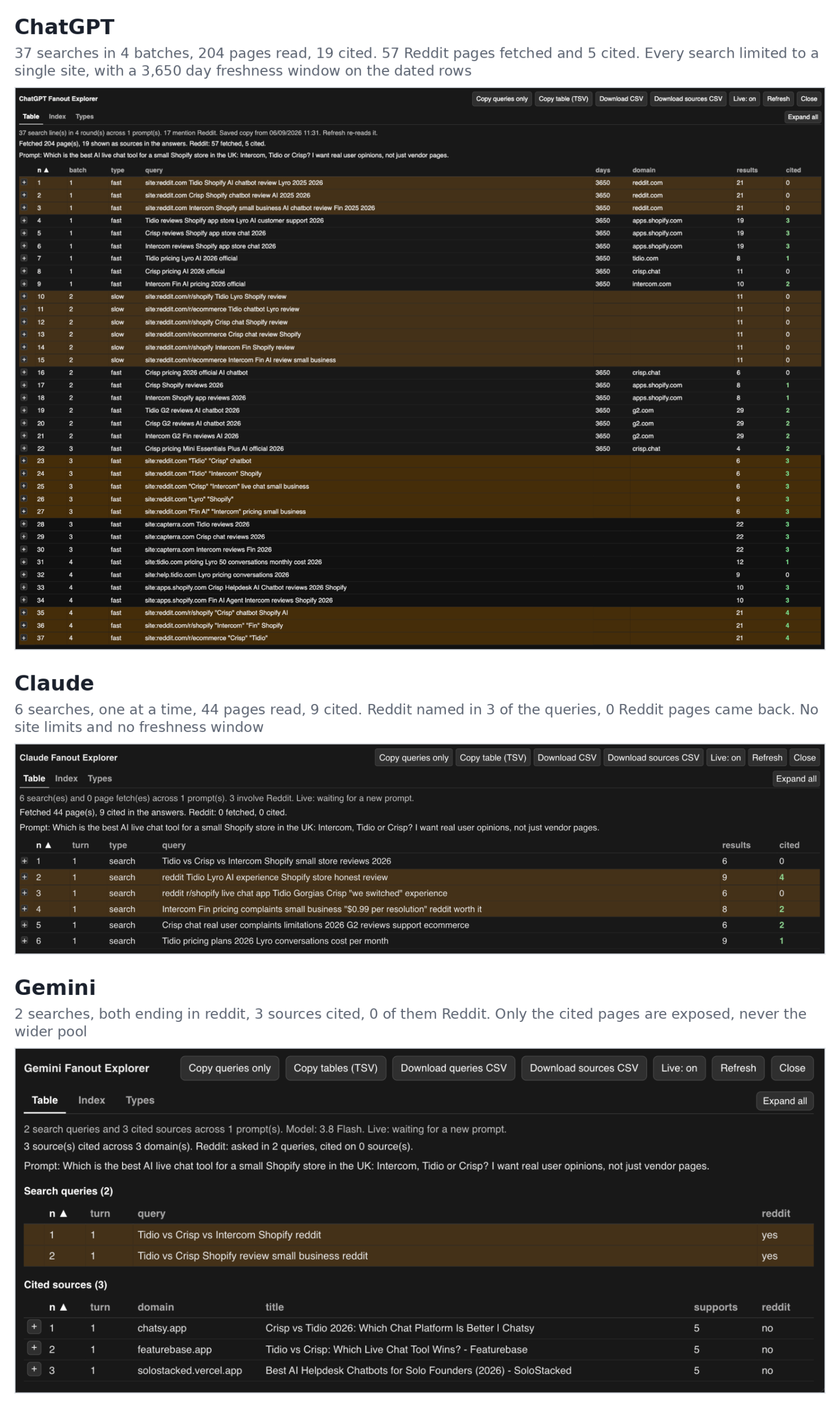
How each LLM broke down the prompt into searches
- ChatGPT casts a wide net, then narrows: It sends a group of searches, reads everything back, then sends another group shaped by what it learned. It did that 4 times. Every row also carries a recency limit and a single website, so one row reads
site:reddit.com Tidio Shopify AI chatbot reviewwith a 3,650 day window, meaning search Reddit only and take anything from the past 10 years. The number is a recency window ChatGPT sends with the search, not a judgement about a page. It does not tell you whether the date is the publish date or the last update. At 3,650 days it is barely a filter at all. - Claude works one step at a time: It searches, reads, rewrites the query and searches again, so you watch it get more specific. It starts at “Tidio vs Crisp vs Intercom Shopify small store reviews 2026” and ends at “Tidio pricing plans 2026 Lyro conversations cost per month”.
- Gemini barely breaks the prompt down: It sent 2 queries, both with “reddit” on the end, then cited 3 pages. There is no wider pool to open, because it does not keep one. My theory is that Gemini leans more on Google’s live index and on its own model knowledge, so it is confident with fewer searches.
On volume Claude and Gemini do far less than ChatGPT, yet the shortlist stays short: Claude cited 9 pages out of 44, ChatGPT cited 19 out of 204 and Gemini cited 3. If your page is not in the first handful of results Claude or Gemini gets, there is no later batch to be included in.
Reddit reliance: Only ChatGPT leans on Reddit
Based on this specific prompt anyway, the live chat comparison, all three were asked for real user opinions and all three wrote “reddit” into a query. What came back split three ways.
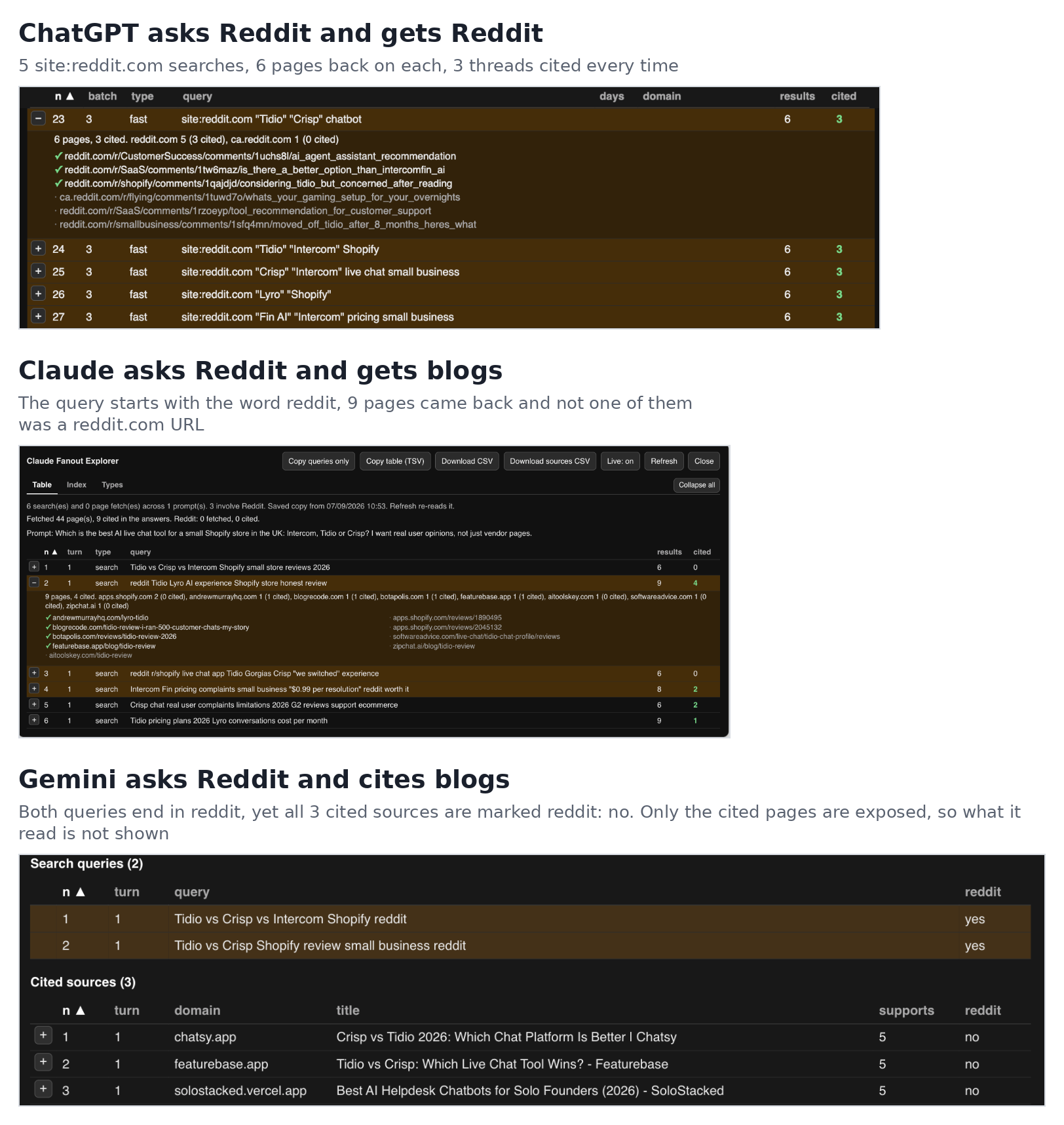
- ChatGPT fetched 57 Reddit pages and cited 5. Reddit is a place it goes back to again and again, with its panel labelling those results as Reddit rather than lumping them in with ordinary web pages.
- Claude wrote “reddit” into 3 of its 6 queries, including one as targeted as
reddit r/shopify live chat app Tidio Gorgias Crisp "we switched" experience- not one Reddit page came back. Across every Claude chat I tested there was not a single reddit.com URL. - Gemini wrote “reddit” into both of its queries and did not cite Reddit either - that is surprising, because Gemini runs on Google’s index and Google is the one search provider that pays for Reddit access, so it is the one that should have Reddit to give, however on these prompts it did not surface any.
What Claude and Gemini cited instead, for the queries that asked for Reddit, were small review blogs: Claude credited names like andrewmurrayhq.com, blogrecode.com and botapolis.com, while Gemini credited featurebase.app, chatsy.app and solostacked.vercel.app, none of which are big, authoritative names.
What prompt 1 showed
One question produced three different shortlists: ChatGPT searched the most and was the only one to bring Reddit back, while Claude and Gemini searched far less and both landed on small third-party blogs, with the review platforms appearing only through Claude.
For a B2B SaaS brand that is three different places to be: On ChatGPT you want to be named in the Reddit threads and to have your own pages updated and cited as a result, on Claude and Gemini you want to be the long-tail comparison post a small blog wrote about your category. Across all of them you want the listings on the review platforms Claude did fetch.
Prompt 2: Best SEO tools 2026
While prompt 1 was mainly there to extend the ChatGPT Fanout Explorer deep dive, this one is a brand new deep dive of its own. It is highly relevant to us as buyers of SEO tools. It is also the one I was most curious about.
The exact prompt I used:
best seo tools 2026
No request for third-party validation, no brand names and no site, just the query, which all three then answered differently.
| What I looked at | ChatGPT | Claude | Gemini |
|---|---|---|---|
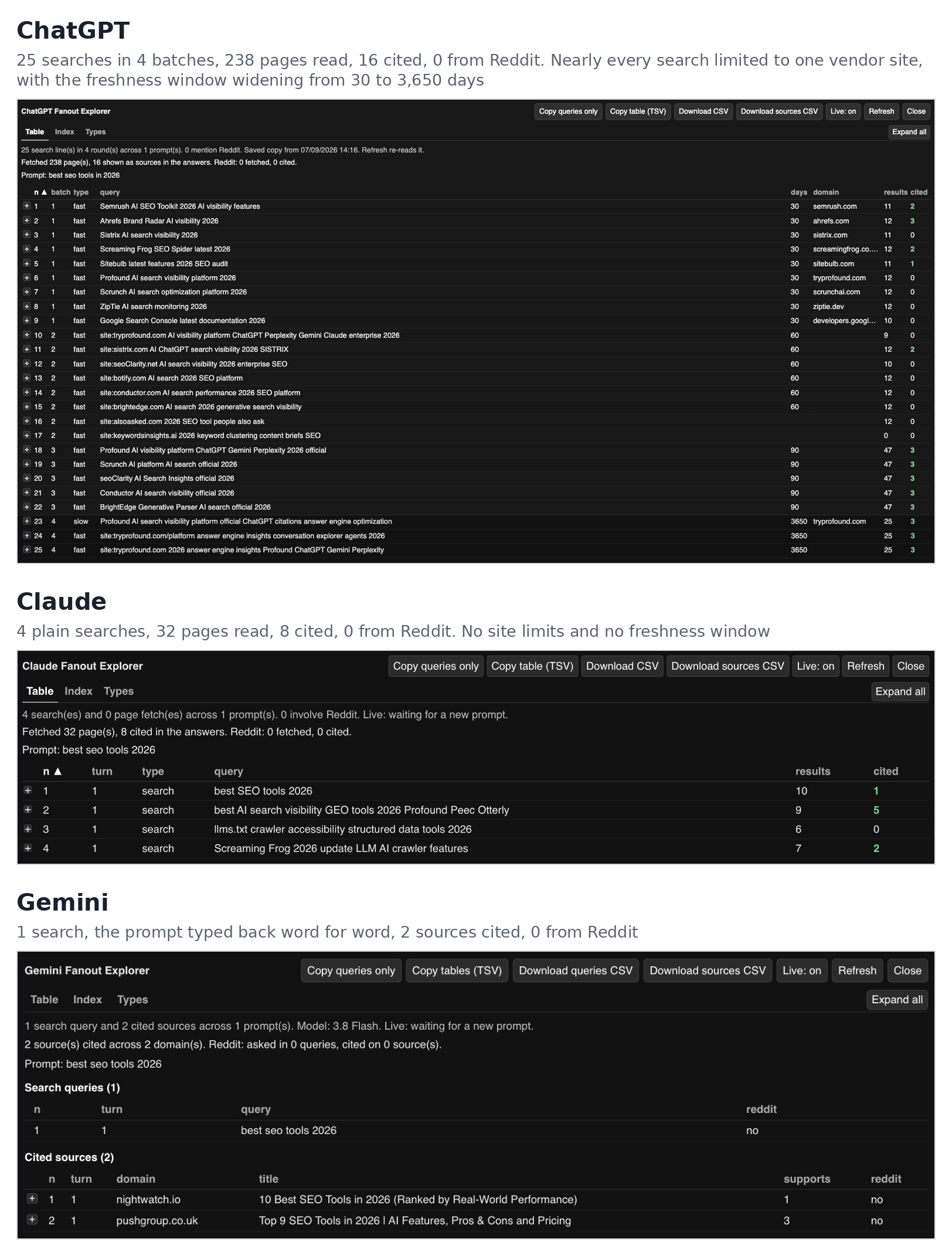
| Searches | 25 in 4 batches | 4 | 1 |
| Pages read | 238 | 32 | Not shown |
| Pages cited | 16 | 8 | 2 |
| Freshness window (how old a page may be) | Widens batch by batch: 30 days, then 60, then 90, then 3,650 (10 years) | Not exposed | Not exposed |
| Limited a search to one site | Nearly every search. It picked one vendor’s own domain and searched only inside it | Never. Every search went to the open web | Never. Its single search went to the open web |
| 0 Reddit pages fetched, 0 cited | 0 Reddit pages fetched, 0 cited | 0 Reddit sources cited | |
| Who got cited | The tools’ own websites and help centres | Small blogs nobody has heard of | Two “best SEO tools” roundups, one on a rank tracker’s blog and one on a UK agency blog |
ChatGPT went to the vendors, one at a time. Its first batch ran 9 searches, each limited to a single tool’s own domain with a 30 day window: semrush.com, ahrefs.com, sistrix.com, screamingfrog.co.uk, sitebulb.com, tryprofound.com, scrunchai.com, ziptie.dev and developers.google.com. The second batch typed site: into the query itself and widened to 60 days. The third dropped the site limit, put “official” in every query and went to 90 days. The fourth spent 3 more searches on Profound alone at 3,650 days. The window widens as it goes: 30 days, then 60, then 90, then 10 years. In other words it began by asking only for pages updated in the last month. Each time that came back thin it accepted older material, until on the last batch it would take anything from the past decade.
Every page ChatGPT cited belonged to the tool it was describing: conductor.com, tryprofound.com, ahrefs.com, semrush.com, screamingfrog.co.uk, sistrix.com and sitebulb.com. Several of those were help centre and support pages, which is where I would least have expected a citation to land. Not one review site, comparison post or roundup got in. That is consistent with the results from another transactional B2B prompt I ran on ChatGPT, WooCommerce vs Shopify for a small ecommerce.
Claude ran 4 plain searches and cited smaller, less established blogs: It started with the prompt itself, then searched for AI visibility tools, for tooling around llms.txt and crawler accessibility, then for Screaming Frog’s 2026 update, with no site limits and no freshness windows. To be clear: It searched for pages about llms.txt, it did not go and fetch anyone’s llms.txt file. The 8 pages it cited were guideflow.com, ayzeo.com, bloomiro.com, kime.ai, promptzone.com, surmado.com, techsy.io and a personal blog on hashnode. Backlinko was among the pages it fetched, yet it never made the answer.
Gemini ran one search: The prompt, typed back word for word. It cited two pages, both “best SEO tools” roundups. One was “10 Best SEO Tools in 2026” on nightwatch.io, which is a rank tracker’s own blog and puts Nightwatch at number 1 in its own list. The other was “Top 9 SEO Tools in 2026” on pushgroup.co.uk, a UK agency blog, so the publisher sells services and has no tool of its own in the list. So one of the two was a self-promotional listicle on a vendor’s own site and the other was a genuine third-party roundup. A tool publishing its own ranking still counts, which makes the “best tools” listicle a page worth writing as well as a page worth getting into.
None of the three went near Reddit: No query mentioned it and no Reddit page was fetched or cited, which settles the Reddit question from earlier: ChatGPT goes to Reddit when the prompt asks for real user opinions and does not source it otherwise, unless something in the request makes it necessary.
ChatGPT reads your own website and your help docs, Claude reads a smaller and less authoritative blog you have likely never heard of, Gemini reads whichever roundup its single Google search surfaces first.
If I had a SaaS website, an SEO tool in this case, this is what I would do:
- Keep the product pages and the help centre genuinely current, because ChatGPT gave each vendor only a 30 day window on its first pass and several of the pages it cited were support articles rather than marketing pages.
- Work to get into the roundups, because those two listicles were Gemini’s entire answer.
- Earn your way into the small blogs, because on Claude the winner is a third-party post you do not own and cannot publish yourself.
* One caveat on the Claude numbers: Claude also reads your past chats, so one of its 4 searches picked up tool names from my own chat history, names that were never in the prompt. It did not change which pages it cited.
How ChatGPT, Claude and Gemini treat fan-outs differently and what to do about it
Across both prompts, four patterns stand out in how the three LLMs behave:
- ChatGPT runs the most searches, Claude far fewer, Gemini the fewest: ChatGPT gathers a group of angles together then adjusts, so your page gets 4 separate chances to enter. Claude asks one question, reads it and asks a better one, so being absent early is hard to recover from. Gemini runs the fewest searches of all, so it likely gathered everything it needs on the first pass.
- ChatGPT tells the index what it wants, Claude and Gemini take what they get: The days and domain values on ChatGPT’s rows are it telling the index what it will accept. Claude and Gemini send plain queries and take the results as they come, which makes their answers a closer read of ordinary search rankings. That is oddly reassuring, because the SEO work you already do is the work.
- Reddit matters, but it is used very differently per LLM: Reddit is a core surface for ChatGPT, yet Claude never got a single Reddit page back in anything I ran and Gemini never cited one, though Gemini only ever shows you the pages it cited. So keep working Reddit for ChatGPT while reading the other two as a signal to widen your net: The small sites that actually get fetched and cited, plus your competitors’ comparison pages, are worth pursuing through partnerships, affiliate placements, digital PR and direct outreach.
- The long tail wins on Claude and Gemini: ChatGPT credited apps.shopify.com, tidio.com and reddit.com, while Claude and Gemini credited small comparison blogs. ChatGPT leans on your first-party assets, your own pages and your help centre, whereas Claude and Gemini lean on a third-party post comparing you to a competitor, which means that post shapes what they tell buyers about you more than your own pricing page does. On-page and off-page together are what make up your AI discoverability. Neither covers you on its own.
Why ChatGPT, Claude and Gemini differ: Three different indexes
The likeliest explanation is that they are not searching the same web:
- Claude uses Brave: Anthropic’s own trust centre added Brave Search as a subprocessor (a supplier it passes data to, in this case the search index behind the answers) on 19 March 2025. Simon Willison found a
BraveSearchParamsparameter inside Claude’s web search tool and matched a Claude search to Brave’s own results, which TechCrunch reported at the time. Anthropic has never announced it, so treat it as unconfirmed evidence, yet evidence nonetheless. - ChatGPT built its own: Tomek Rudzki’s write-up for Peec AI describes an in-house index family with its own crawler and separate verticals, blended with results from external providers. Reddit arriving with its own tag fits an index that treats Reddit as a pool of its own.
- Gemini uses Google: No mystery there, it is Google’s own search grounding. Which is what makes the Reddit blank interesting, because Google pays Reddit 60 million dollars a year for access and is the only search provider Reddit still lets index its content, so Gemini is the one LLM that should be able to lean on Reddit, yet on these prompts it chose not to.
The Reddit blank on Claude fits the index too: Reddit blocked search engines other than Google in July 2024 and it remains the case today: Bing, DuckDuckGo and Brave all cannot show recent Reddit. Claude runs on Brave, so it has very little Reddit to give back.
There is likely a licensing layer on top of that. No LLM outside Google has an agreement with Reddit. Google’s own deal may not stretch as far as citing individual threads inside an answer, so the LLMs can be relying on Reddit while being limited in what they are able to cite from it.
My 2-pence: Where you rank on Brave (you can search it yourself at search.brave.com) hints at what Claude sees. Your Google rankings hint at what Gemini sees. ChatGPT’s index is its own and closed, so there is no equivalent check.
A workflow with all three Fanout Explorers
- Pick the 10 prompts your customers would actually type, the buying ones, which is stage 2 of an AI search visibility audit.
- Run each prompt three times, once in ChatGPT, once in Claude and once in Gemini, with the matching bookmarklet open.
- Copy the queries from all three panels into one keyword list and mark which tool wrote each one.
- Note the pages cited in each, the quick version of a citation source audit. Where the same page is cited by more than one, that is the strongest page you have.
- Read the Reddit rows in ChatGPT and the domain spread in Claude and Gemini, since those are the gaps that need different fixes.
- Download the CSVs and file them with the date.
- Fix what the tables point at: Your own pages for ChatGPT, third-party comparison coverage and the review platforms for Claude and Gemini.
- Rerun next month and compare the exports.
It is a couple of hours the first time and half an hour a month after that, so you can answer “what are the LLMs actually doing with our category” with data.
What analysing ChatGPT, Claude and Gemini fan-outs means for your AI search strategy
Looking at two prompts across three LLMs, all three had a distinct way of turning a question into searches. These are my takeaways:
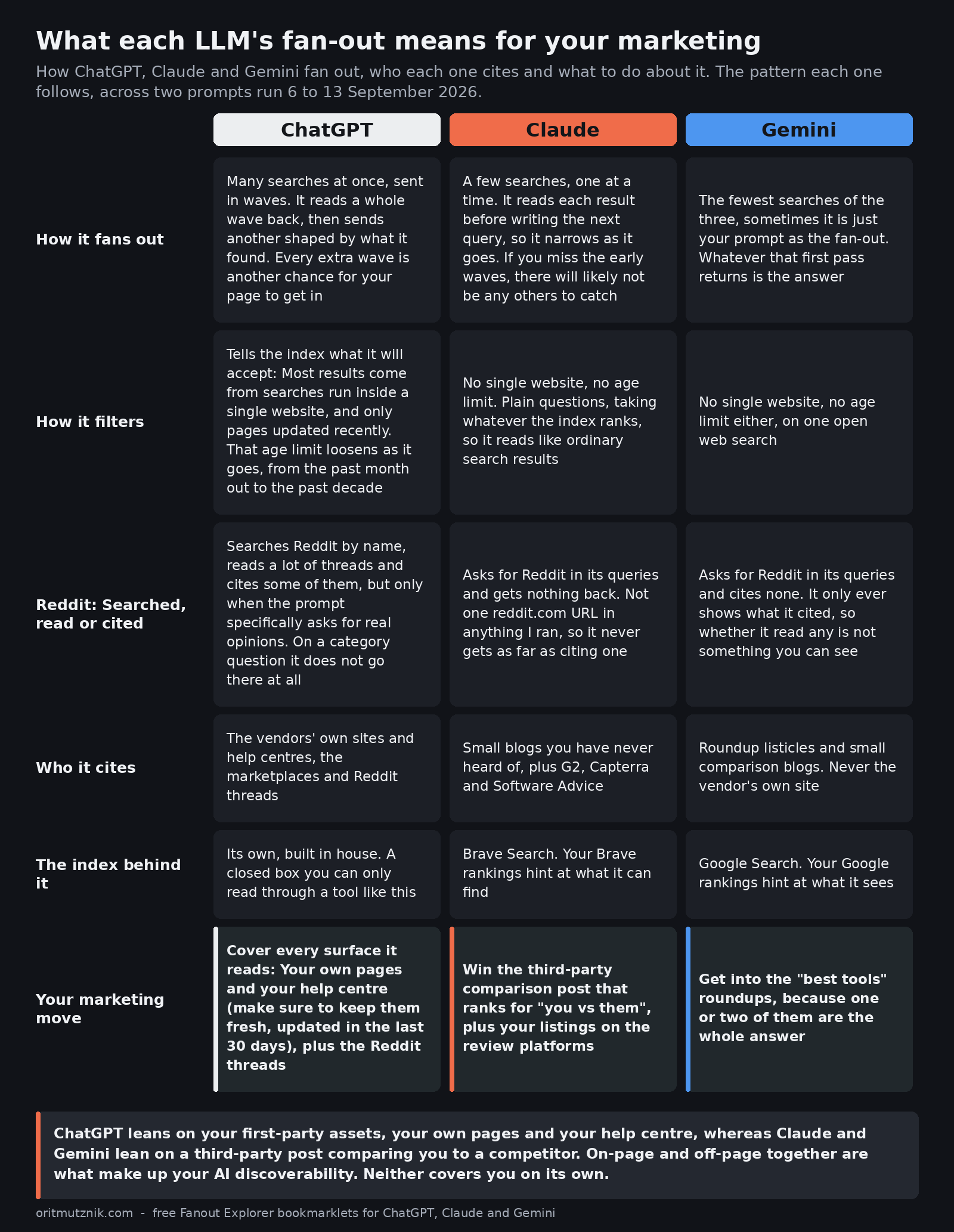
- ChatGPT rewards being everywhere it looks: Your own pages, the marketplaces and the Reddit threads on an opinion-led prompt, then your own website and help centre on a category prompt. It searches the most, so it gives you the most ways in.
- Claude and Gemini reward the long tail: The small comparison blog, the review platform listing and the third-party post that ranks for “you vs a competitor”. On both prompts neither of them cited the vendor’s own site.
- Keep your product and support pages current: On “best seo tools 2026” ChatGPT gave each vendor a 30 day freshness window on its first pass, with several of the pages it cited being help centre articles rather than marketing pages.
- Roundups are most of Gemini’s answer: It ran a single search and cited two “best tools” listicles, so a place in those lists is most of the game there.
- Reddit is chosen mainly by one LLM for now: Keep it for ChatGPT on prompts that ask for real opinions. Treat its absence elsewhere as a nudge to invest in the smaller sites Claude and Gemini do fetch, through partnerships, affiliate placements, digital PR and outreach.
- The prompt decides the playing field: Ask for real user opinions and ChatGPT goes to Reddit and the review sites, ask a category question and it goes to the vendors instead, so it is the same tool playing by different rules.
- You can sense-check two of the three: Your Brave rankings track what Claude can find and your Google rankings track Gemini. ChatGPT stays a closed box you can only read through a tool like this.
I would encourage you to run this on your own prompts and your own data, because your category will likely not behave like the prompts I have tested here. Let me know how it goes, or send me your feedback on the tools, here or on LinkedIn.
* A note on these prompts. These LLMs change their data retrieval strategies daily, so all of this is true for the day it was run. The live chat prompt ran on ChatGPT and Claude on 6 and 7 September 2026 and on Gemini on 12 September. The “best seo tools 2026” prompt ran on ChatGPT on 7 September and on Claude and Gemini on 13 September, each on its default model. The insights apply mainly to the queries I tested. They represent plenty of other B2B SaaS queries to me, because it is what I am seeing across the board, so treat the specifics as a snapshot.
ChatGPT, Claude and Gemini fan-out FAQs
Do the bookmarklets send my chats anywhere?
No. Each one reads the conversation from the LLM’s own API using the session you are already logged in with, builds the table in your browser and keeps a saved copy in your browser’s local storage. Nothing is sent to me or anyone else. The short ChatGPT and Claude bookmarklets fetch their code from GitHub through jsDelivr, a public CDN, so jsDelivr sees the IP address of whoever clicks it, the same as any script served from a CDN. The Gemini one and the standalone versions never contact anything but the chat site. The whole of the code is on the install pages and on GitHub, so you or a developer you trust can read it before you use it.
Why does the Gemini panel look different from the other two?
Because Gemini exposes less. It hides the search queries but stores them, which is why the tool can show them. It keeps only the sources it cited, not the wider pool it read. So the Gemini panel has a queries table and a cited sources table, with no results or freshness columns, because there is nothing there to show.
Can I run the bookmarklets on each other’s sites?
No. Each one reads a different API, so the ChatGPT bookmarklet only works on chatgpt.com, the Claude one on claude.ai and the Gemini one on gemini.google.com. All three run in Chrome, Edge and Brave on a desktop, logged in, on your own chats. None work in the desktop apps, which have no bookmarks bar.
Work with me on your AI search visibility
If you want help turning what the fan-outs show you into a content and citation plan, or a second pair of eyes on what the LLMs are doing with your category, tell me what you are seeing.