


Why I compiled this AI Search Optimisation Glossary
I wrote AI Search Optimisation 101 as one long argument: How the industry got from SEO to AEO, GEO and Search Everywhere Optimisation and what the evidence actually says about each claim. This is the reference half of that job: 156 terms defined once in plain English, including the ones you will meet in a vendor demo or a LinkedIn argument and have to nod along to. Tools sit in the alphabet under their own names, with a line on what each one actually does for AI search, which is not always what its homepage claims and every term carries its own anchor so a colleague can be sent straight to the definition they need. Agents and the protocols they run on have a companion piece, the Agentic Search Optimisation Glossary, because that layer is about completing tasks and this one is about being found.
How a page becomes an AI citation
Most of the terms below describe one pipeline. Here it is end to end. The most important part is that there are two paths.
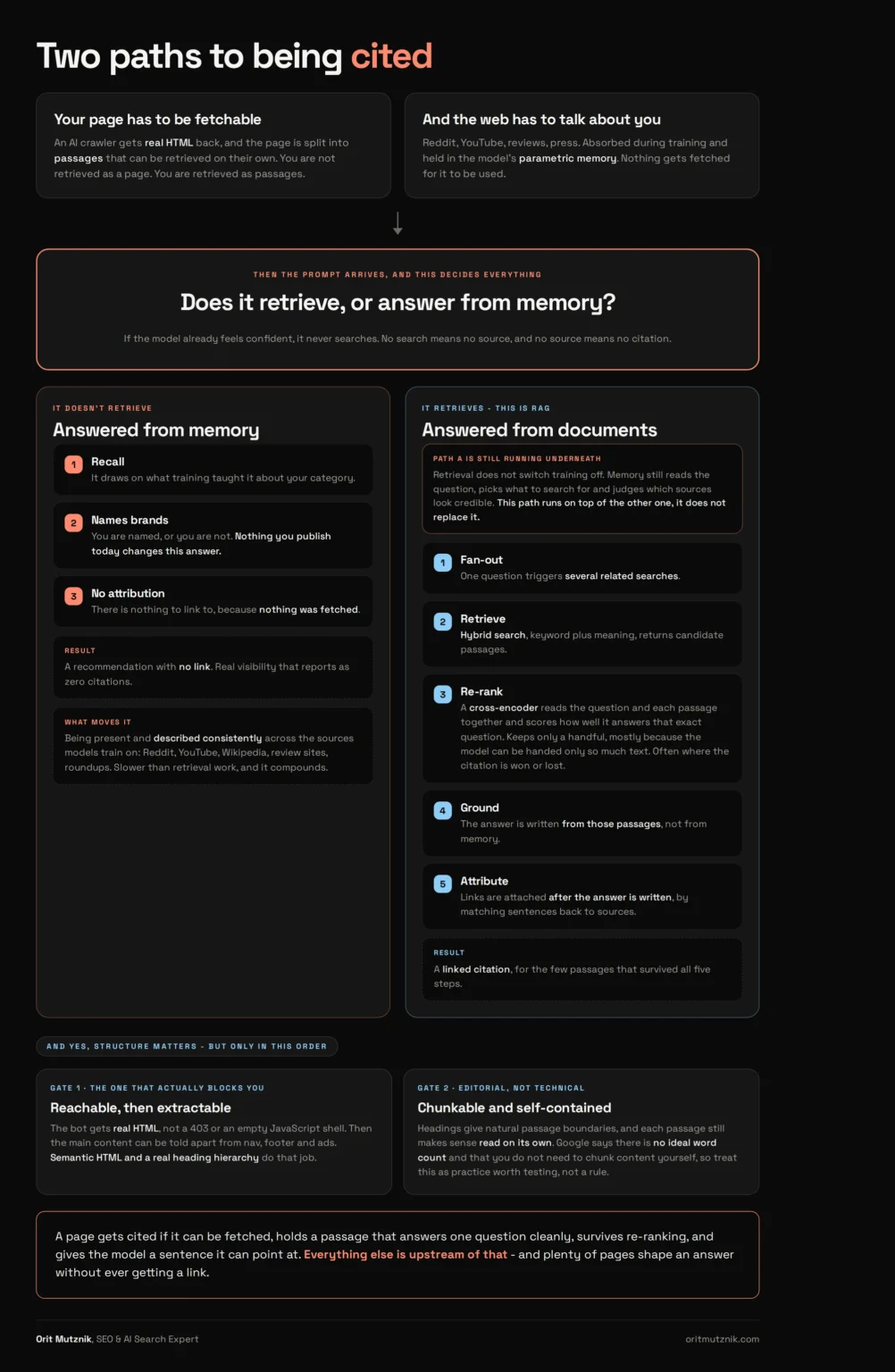
Before anyone asks anything
- Your page has to be fetchable by AI crawlers, then it is broken into passages. You are not stored as a page, you are stored as passages
- Separately, what the web says about you is absorbed during training and sits in parametric memory, where nothing needs fetching for the model to use it
Then the prompt arrives
The assistant makes a retrieval routing decision before anything else: Search the web, or answer from what it already holds.
Path A: It does not search
- It answers from parametric memory and can still name your brand
- Nothing was fetched, so there is nothing to link to
- That is real visibility reporting as zero citations, which is the most common reason a dashboard disagrees with what you see in the assistant
Path B: It searches, which is RAG
- Query fan-out turns one question into several searches
- Hybrid search returns candidate passages
- Re-ranking cuts those down to a handful
- Grounding makes the model write from what survived
- Attribution attaches the links afterwards
Memory keeps running throughout, because the model still reads the question, picks what to search for and judges which sources look credible. The second path runs on top of the first.
Does the page need structuring? In this order
- Retrieval eligibility. A 403 or an empty JavaScript shell ends it here
- Content extractability, which is where semantic HTML earns its keep
- Chunking, so your headings mark where a passage starts and stops
- Self-contained passages that still make sense read on their own
Google says publishers do not need to chunk content themselves and that there is no ideal word count, so treat 3 and 4 as good editorial practice worth testing. Steps 1 and 2 are what stop you being cited: One announces itself with a 403 in your logs, the other announces nothing at all, which is why I check it on every audit even when the crawl report looks clean.
The full version of this diagram sits at the end of the glossary.
Now that we got that out of the way, here is the full AI search glossary. Use the table of contents at the top to navigate between the letters (back to top).
AI Search (AEO/GEO/LLMO) Glossary
A to B
AccuRanker AccuLLM
AccuRanker’s AI search module, tracking ChatGPT, Perplexity, Google AI Overviews and AI Mode. It reports brand visibility, citation analysis, sentiment and share of citations and it separately tracks how often a model triggers a live web search instead of answering from memory. That last metric is more useful than it sounds, because it tells you whether a prompt is winnable this week or not at all.
AEO (Answer Engine Optimisation)
The tactics that get your brand used when a system answers a question directly, set out in Google’s AI optimisation guide. In practice: Digital PR and offsite mentions, being described accurately in the comparison pages and reviews that get cited, answering the real question plainly near the top of a page and keeping that page fetchable. Google’s own position is that “AEO/GEO is still SEO” for its products, which is true for Google and leaves ChatGPT, Claude and Perplexity out of it. I have never seen it justify a separate team.
AI Mode
Google’s conversational search surface for longer, multi-part questions and follow-ups. It runs its own query fan-out independently of AI Overviews, returns answers roughly 4 times longer and leans heavily on encyclopedic sources. Ahrefs found only 13.7% of its citations overlap with AI Overviews, so Google’s two AI surfaces disagree with each other constantly.
AI Overviews
The generated summary that appears inside ordinary Google results, now on roughly half of US queries. Pages have to be indexed and snippet-eligible to be used. The number that changed my planning: Ahrefs found citations from top-10 pages fell from 76% to 38% in 6 months, so ranking no longer predicts being cited.
AI referral traffic
The visits your analytics can identify as coming from an AI assistant. Conductor’s 2026 benchmark put it at 1.08% of total traffic across 13,770 enterprise domains, ranging from 0.25% to 2.80% by industry. Read it as a floor, because attribution leaks badly across apps and surfaces and there is no defensible multiplier for the missing share. Anyone offering you one has made it up.
AI SEO
A broad label for some combination of everything else in this glossary, reached for when someone would rather avoid picking between AEO, GEO and LLMO. My view is that AEO and GEO describe the same retrieval-time work under two names, while LLMO is the one genuine outlier, because it aims at the model’s own understanding and moves on a training cycle rather than this week. The tactics behind all of them were mostly in the SEO toolkit years before anyone said GEO out loud, such as digital PR, Reddit and listicles and a few are genuinely new, such as llms.txt and the agent protocols. There is a fuller version of that argument in AI Search Optimisation 101.
AI slop
Mass-produced, low-information AI-generated content. It is worth naming because publishing it under your own domain is now a reputational and a ranking risk and because a lot of what circulates as AI search advice is exactly this.
AI visibility platform
The tool category that samples prompts repeatedly across assistants and reports where your brand appears. Profound, Peec AI, Otterly, Ahrefs Brand Radar and the Semrush AI Visibility Toolkit all sit here. None of them share a methodology, so two tools reporting different numbers for the same brand are often both right.
ai.txt
A proposed root-level file declaring how your content may be used for AI training. Adoption is negligible, no major model provider has committed to honouring it and I have included it here mainly so you can recognise it when a vendor mentions it.
Answer engine
A search surface that returns a resolved answer as the main output, with links as supporting evidence. The distinction from a search engine matters commercially, because being the answer and being on the list of links are different results with different value.
Applebot-Extended
Apple’s crawler token for opting out of AI training use, the Apple equivalent of Google-Extended and blocking it leaves Apple’s ordinary search indexing alone.
Attribution
Assigning credit for a conversion across the touchpoints that led to it. AI search breaks it in a specific way: The influencing exposure happens inside an assistant your analytics cannot see, so the visit that eventually arrives looks like branded search or direct. Which is why branded search and direct visits belong in the same report as the referral number.
Bing Webmaster Tools AI Performance
Microsoft’s first-party report showing when your site is cited in Copilot and Bing’s AI answers, which URLs were referenced and how citation activity trends. It went to public preview in February 2026. Google shipped its own generative AI reporting in June 2026 and Bing still gives you citation-level detail that Google’s impressions-only view does not.
Bingbot
Microsoft’s crawler. It matters well beyond Bing traffic, because Bing’s index grounds Copilot and has historically fed other assistants, so being missing from Bing means being missing from those surfaces entirely.
BM25
The keyword-ranking formula behind most sparse retrieval, scoring a passage on how often your terms appear in it and weighting down terms that are common everywhere. It is decades old and still doing real work inside AI search, which is why exact product names and model numbers have to be on the page in the words people use.
Bot management
The edge layer that classifies traffic as human, good bot or bad bot, usually with a machine-learning score. It is also the single most common accidental reason an AI crawler cannot reach your content and nobody notices until someone reads the logs.
Botify
An enterprise SEO platform whose strength for AI search is the crawl and log side: Server-side analysis of AI crawler behaviour, plus agent-facing product feeds and fast content delivery for agents. If your question is what the bots are actually doing on your site, this is that category of tool.
Brand co-occurrence
How often your brand appears alongside your category and your competitors across the web. It shapes whether a model treats you as part of the consideration set at all, which is why third-party mentions can matter more than another page on your own blog.
Branded search lift
An increase in people searching your brand name directly. It is one of the few workable proxies for AI exposure you cannot otherwise measure, because someone who saw you in an answer often goes and searches your name afterwards.
Bytespider
ByteDance’s crawler, widely reported for aggressive crawl rates and inconsistent robots.txt compliance. In every log audit I have run it has been a bandwidth line item, never a visibility opportunity.
C to D
C2PA (Content Credentials)
A cryptographic provenance standard that embeds tamper-evident metadata about how a piece of media was made and edited, backed by Adobe, Microsoft, Google and OpenAI.
cats.txt
A file about office cats and their purring frequency, invented by Mark Williams-Cook to test the 4 proofs people offer that llms.txt improves AI visibility. It passed all 4. Published in August 2026 and the best piece of methodological trolling the industry has produced. It settled the argument.
ChatGPT
OpenAI’s assistant, at around 900 million weekly users and the default for most people. It searches the live web mid-conversation through OAI-SearchBot and leans on encyclopedic authority, with Wikipedia alone accounting for 7.8% of its citations. Semrush found the pages it cites rank 21st or lower almost 90% of the time.
ChatGPT-User
OpenAI’s user-triggered fetcher, used when someone in a conversation asks it to go and read a specific page. It is a different job from GPTBot, which collects training data and OAI-SearchBot, which builds the search index. Reporting all 3 as one “AI bot traffic” number destroys the only useful thing in the data.
Chunking
Splitting content into passages that can be retrieved and quoted on their own. Google’s AI optimisation guide says publishers do not need to do this, that its systems can find a relevant passage inside a page covering several topics and that there is no ideal word count. Clear headings and self-contained explanations remain good editorial practice, so test them. Anyone presenting fixed paragraph lengths as a confirmed Google requirement is overreaching and I would push back on that in the room.
Citation
A link or source attribution shown alongside a generated answer. It behaves nothing like a backlink: It is not permanent, it is not a vote and it can disappear between two runs of the same prompt.
Citation drift
The tendency of cited sources to change over time for the same prompt. Profound found 40.5% to 59.3% of cited domains changed within a single month across Perplexity, Copilot, ChatGPT and AI Overviews, rising to 70% to 90% over 6 months. It is the reason a single screenshot proves nothing.
Citation rate
The share of runs across your prompt set in which your domain gets cited. It only means something if the prompt set, the platforms and the number of runs stay the same between measurements.
Citation share
Your proportion of all citations for a topic or prompt set and also the name of a metric Microsoft added to Bing Webmaster Tools in 2026. Useful because it is relative, so it survives the volatility that makes absolute counts unreadable.
Claude
Anthropic’s assistant, skewing technical and B2B. It runs iterative searches and cites what it read and its fetch tool does not render JavaScript at all, so a client-rendered page that Googlebot handles fine is simply invisible here. Profound compared its citations against Brave’s results and found 86.7% overlap on a small sample.
ClaudeBot
Anthropic’s crawler. Claude-User and Claude-SearchBot are the separate user-triggered and search-indexing agents and telling them apart in your logs is the difference between knowing your content is being absorbed and knowing customers are asking about you today.
Client-side rendering
Content that only exists after the browser runs your JavaScript. The major search crawlers render it: Googlebot in a queued stage that costs Google real resource and Bingbot with an evergreen Chromium engine since 2019. The AI retrieval fetchers mostly do not. I ran a bot log audit on a large consumer platform where the main domain drew assistant citations in the hundreds of thousands and its developer documentation subdomain drew double digits, a gap of roughly 1,000 to 1, because the docs were a client-rendered single-page app.
Cloaking
Serving different content to bots than to humans. It breaks Google’s guidelines, it is reappearing as an AI search tactic and the upside is capped while the downside is not.
Cloudflare AI Crawl Control
Cloudflare’s dashboard for observing, allowing, blocking or charging AI crawlers, formerly called AI Audit. It also reports whether crawlers are actually respecting your robots.txt, which is the sort of thing you can only learn at the edge.
Common Crawl (CCBot)
A nonprofit open web archive and its crawler, historically a major training data source and the route by which your content reaches models you never gave access to directly.
Conductor
An enterprise SEO and AEO platform covering brand visibility across assistants, always-on monitoring of how AI bots crawl your site and content tooling. It also publishes the AEO/GEO benchmark report that most of the credible “AI traffic is about 1%” figures come from.
Content extractability
Whether a machine can pull your main content out of the page cleanly, separating it from navigation, footers, cookie banners, related-post rails and ads. It sits between retrieval eligibility and chunking: The page loaded and the question is now whether the part you wrote is the part that gets read. Semantic HTML and a real heading hierarchy are what make the separation reliable.
Content Signals Policy
Cloudflare’s extension to robots.txt letting publishers express separate intent for search indexing, AI input and AI training. It has been added by default to millions of managed robots.txt files, which makes it the most widely deployed thing in this section by a distance.
Context window
The maximum amount of text a model can hold in one request, covering the system prompt, retrieved passages, the conversation and the answer. Your page does not arrive whole, it arrives as a few hundred words competing for space with everyone else’s.
Copilot (Microsoft)
Microsoft’s assistant, used mostly for work questions inside Microsoft 365 and now folded into Bing as Copilot Search. It runs on Bing’s index, so Bing indexing is the gate.
Cosine similarity
The maths behind most vector search: How close two pieces of text sit in meaning, measured as the cosine of the angle between their embeddings. You will never tune it and it explains why paraphrasing a competitor’s page gets you nowhere.
Crawl budget
The practical ceiling on how much of your site a given crawler will fetch in a period. It used to be a large-site problem. On the audit I keep referring back to, 19 AI providers were crawling one site at once and several of them were not gentle.
Crawl-to-refer ratio
Cloudflare’s metric dividing an AI operator’s crawl requests by the referral clicks it sends back. It is the number underneath every “AI takes more than it gives” argument and it is the reason pay per crawl exists.
Dark traffic
Sessions arriving with no usable referrer, which land in Direct and get credited to nothing. A large share of AI assistant traffic ends up here, particularly from mobile apps and from anyone who copied a link out of an answer.
data-nosnippet
An HTML attribute that excludes one specific element from snippets while leaving the rest of the page eligible. It is the surgical version of nosnippet and Bing added support in late 2025.
Deep research
A mode where an assistant browses many sources over several minutes and returns a long report with an extended source list. It picks sources differently from a standard answer, which makes it a high-value citation surface that almost nobody tracks separately yet.
Dense retrieval
Finding content by meaning, using embeddings, so paraphrase and synonyms get caught. It is weak on exact product names, model numbers and rare terms, which is why most real systems run it alongside keyword search.
Digital PR
Earning coverage and mentions on other people’s sites. It sat in the SEO toolkit for years before anyone said GEO out loud and LLMs have made it more valuable, because third-party descriptions now feed the answer directly.
DOM (Document Object Model)
The parsed, structured version of a page after the browser has built it. Anything reading the DOM sees whatever your JavaScript produced, which is a different thing from your source HTML and the gap between those two is where a lot of AI visibility goes missing.
E to G
E-E-A-T
Experience, Expertise, Authoritativeness and Trustworthiness, from Google’s quality rater guidelines. It has never been a score, whatever anyone tells you. It is a fair checklist for the question models are implicitly asking, which is whether repeating your claim is safe.
Embedding
A numerical representation of meaning, so that text can be compared mathematically. Content gets chopped into passages and stored as embeddings in a vector store and retrieval is largely a matter of which passages sit closest to the question.
Entity
A thing a system can identify and hold facts about: A brand, a product, a person, a place. Most brand problems in AI answers turn out to be entity problems, where the system has merged you with something else or never resolved who you are.
Entity disambiguation
Resolving an ambiguous name to the right real-world thing. If your brand shares a name with a town, a band or a bigger company, this is why the answers about you are strange and sameAs is where you start fixing it.
Entity home
The single canonical URL that best represents an entity, usually a homepage or an About page and the job is to get every system converging on the same one, because 4 near-duplicates is how entity confusion starts.
Entity map
A documented model of the entities your brand should be connected to and how: Products, people, categories, locations, competitors and the topics you want to own, each with the identifiers that prove it, such as Wikidata, Wikipedia, a company register, LinkedIn and your own entity home. It is a working document rather than a published standard, so nobody validates it for you. I build one before any schema markup work, because sameAs links and internal linking are only as good as the model behind them.
Evertune
An AI brand measurement platform whose method is its differentiator: It samples each prompt 100 times across a panel of models. Given how much answers move between runs, repeated sampling is the only version of this measurement I would defend in a meeting.
Fine-tuning
Further training a base model on a narrower dataset to change its behaviour or domain knowledge. It has nothing to do with your brand visibility and it turns up in vendor decks often enough to be worth recognising.
First-hand experience
Evidence that you actually did, used, visited or tested the thing, expressed in specifics an outsider could not invent. It is the most reliable form of information gain available to most businesses and it is the part of content strategy that cannot be outsourced to a model.
Freshness
Whether the facts on a page are current. It is a live retrieval signal in a way it never was for ranking, because a price that changed last week is simply wrong in today’s answer if the page still says otherwise.
GA4 Unassigned
The channel bucket where visits land when GA4 cannot classify them. ChatGPT referrals frequently end up here, because OpenAI adds a utm_source without a utm_medium. If your AI traffic looks like zero, check Unassigned before concluding anything.
Gemini
Google’s assistant, at around 950 million monthly app users as of Alphabet’s Q2 2026 results. It answers from Google’s index, plus your Workspace files if you connect them and its source mix looks more like Perplexity‘s than like AI Overviews‘ despite the shared parent company.
Generative engine
Any system that composes a written answer from retrieved sources, in place of a ranked list of links. The G in GEO.
GEO (Generative Engine Optimisation)
The tactics that get your brand mentioned or cited inside a generated answer, which in practice is the same toolkit as AEO: Digital PR, Reddit and community presence, earning a place in third-party listicles, publishing original data with a stated methodology and server-rendered pages a retrieval bot can read. The term gained momentum after a 2023 research paper proposed a way to measure source visibility, later accepted at KDD 2024. That paper found citations, quotations and statistics improved source visibility in its experimental setting, which is worth testing and short of a rule.
Google Business Profile
Your local business listing. Google’s own AI optimisation guidance points local brands here, because accurate hours, locations and services give its systems current structured facts to answer from.
Google-CloudVertexBot
Google’s crawler for site owners who have asked it to crawl their own content for Vertex AI agents. This is your own grounding data and it looks far more significant in a log file than it is.
Google-Extended
The token that controls whether your content is used to train and ground Gemini. Blocking it leaves Google Search indexing and snippets untouched and it does not remove you from AI Overviews or AI Mode, which run on Googlebot. That is 3 separate levers people routinely confuse for one.
Google-GeminiNotebook
A user-triggered fetcher that retrieves pages someone has pasted into Google’s notebook product. It was called Google-NotebookLM and Google lists that token as supported only until August 2026, so update any rule referencing the old name. Like other user-triggered fetchers it generally ignores robots.txt, on the logic that a person asked for it.
Googlebot
Google’s crawler and one of the few that fully renders JavaScript, in a queued stage that runs after the initial crawl. Bingbot has rendered with an evergreen Chromium engine since 2019 and Applebot renders too. The gap that matters is not search crawlers, it is the AI retrieval fetchers, most of which read raw HTML and stop there.
GPTBot
OpenAI’s training crawler. Traffic from it means your content is being absorbed for a model that ships later, which is a different piece of news from a customer asking about you today.
Grounding
Forcing a model to answer from retrieved documents, so every claim can be traced back to a source. Almost all of your commercial visibility travels through grounding, which is the good news, because it runs on live pages, so what you publish today can change the answer today.
H to K
Hallucination
A fluent, confident model output that is wrong, including invented statistics and fabricated sources. For brands the version that bites is the plausible one: A discontinued product, an old price, a competitor’s feature attributed to you. Several tools now measure it and none of them can fix it for you.
Hybrid search
Running dense and sparse retrieval together and merging the results. It is the default in serious retrieval systems and it is why both your exact product names and your plain-English explanations have to be on the page.
Indexing
Whether content can be stored and retrieved later. Google requires supporting pages for AI Overviews and AI Mode to be indexed and snippet-eligible, so there is no technical route around it whatever anyone is selling.
IndexNow
An open protocol, launched by Microsoft and Yandex, for pushing new and updated URLs to search engines the moment they change, so you are not waiting to be crawled. Because Bing’s index grounds Copilot, it does AI search work as well as SEO work.
Inference
Running a trained model to produce output, as opposed to training it. Inference-time retrieval is the compound that matters here: The system fetching live pages at the moment someone asks, which is the part you can influence.
Information gain
How much a document adds that is not already in the existing corpus. It comes from a Google patent and it is the clearest available explanation for why a competent summary of 10 other pages gets cited by nobody.
JavaScript rendering gap
The gap between what the search crawlers can read and what the AI retrieval fetchers can read. Googlebot and Bingbot both render; most AI fetchers pull raw HTML and never execute JavaScript, so an empty application shell costs you the copy, the internal links, the product details and the evidence.
JSON-LD
The format Google recommends for structured data, sitting in its own script tag. Google has been clear that there is no special AI schema and no citation switch, so use it for the purposes it always served.
Knowledge cutoff
The date after which a model learned nothing new during training. It is why an assistant confidently describes a product you discontinued and why entity work aimed at the model itself pays out on a training cycle, which is months away and not this quarter. Providers do not always publish exact dates, so treat any figure you see as inferred.
Knowledge graph
A store of entities and the relationships between them, as opposed to a store of documents, which is how a system knows a person founded a company and not simply that both names appeared on the same page.
Knowledge panel
Google’s entity summary box and a useful observable proxy. If Google has yet to resolve your brand confidently as an entity, this is usually where you see it first.
Known Agents
An AI bot analytics service, formerly called Dark Visitors, covering real-time crawler monitoring, referral tracking from assistants and a robots.txt file that updates itself as new bots appear. Half the articles you will read still cite the old name and the old domain.
L to M
Large language model (LLM)
A model trained to predict likely sequences of text, which is what produces the prose in an AI answer. Worth remembering that it is doing something more mundane than deciding whether to recommend you: Usually it is running a search and reading what comes back.
Listicle rank effect
The relationship between where a brand sits in a cited listicle and how visible it is in generated answers. Peec AI analysed almost 200,000 AI responses and found the effect real but varying by industry and engine. The practical read: Be in someone else’s listicle and earn the place.
LLMO (Large Language Model Optimisation)
The tactics aimed at how the model itself understands your brand, as opposed to what it retrieves today: Consistent descriptions across every source it was trained on, entity signals such as sameAs and Wikidata and enough independent third-party coverage to shift a consensus. It is the slowest of the 4 acronyms to move and the hardest to attribute, because you are working on a model version that has not shipped yet.
llms-full.txt
The expanded companion to llms.txt, holding full content in markdown rather than links and descriptions. The same evidence problem applies and one I found in an audit ran to hundreds of kilobytes, well past the point where a model stops reading.
llms.txt
A proposed plain-text file summarising your site for language models. Ahrefs tested 137,000 domains and found 97% of published files received no requests at all in a month and no AI bot ever requested one that did not exist. It works as a discovery mechanism for coding agents and has never been shown to lift AI search visibility. If you keep one, link it, keep it small and treat it like code.
Log file analysis
Reading raw server logs to see what crawlers actually fetched. It is the only place AI bot behaviour shows up. It never appears in a content audit, which is why so much AI search work is planned without it. On the audit I keep referring back to, near the top of the most-crawled list sat internal tracking redirects and a landing page for a product the company had discontinued years earlier, still being fetched in volume. Nobody built that deliberately and nobody could see it until someone opened the logs.
Main content extraction
The step where a system decides which part of your HTML is the article and which part is furniture. Readability-style algorithms do this, the same logic that powers browser reader modes, leaning on semantic HTML, heading structure and the ratio of text to links in a block. Get it wrong and your writing is read as boilerplate, or dropped.
max-snippet
A robots directive capping how many characters Google may use as a text snippet. Setting it to 0 is effectively nosnippet, which also removes the page from AI Overviews eligibility, so it is an expensive setting to apply casually.
Memory
An overloaded word in AI search, covering three different things. Parametric memory is what the model holds from training. The context window is what it holds during the current conversation. Then there is an assistant’s saved memory of a user, such as ChatGPT’s Memory feature, which carries preferences and facts between chats. That last one matters for measurement, because two people running the same prompt set can get different brands back.
Mention
Your brand being named in an answer, with or without a link to you. It is a different outcome from a citation and it moves independently, which is why blending them into one visibility score hides both.
Merchant Center
Google’s product feed platform. Google’s AI optimisation guidance points ecommerce brands here, because accurate prices, availability and product details give its systems current structured facts. This is the part most SEO teams underrate, usually because feed accuracy belongs to someone else in the business.
N to P
Nightwatch
A rank tracking platform with an AI visibility module covering ChatGPT, Claude, Gemini, Perplexity and Copilot. Its angle is connecting your Google rankings to your AI visibility, a premise that holds up well for Perplexity and much less well for ChatGPT.
noindex
The directive that removes a page from search results entirely. People reach for it when they mean nosnippet or Google-Extended and that mix-up is one of the more expensive mistakes available in this field.
Non-commodity content
Google’s own phrase, from its AI optimisation guide, for content that goes beyond a summary of pages that already exist: First-hand experience, original viewpoints, proprietary data. It is information gain, expressed in language a stakeholder will actually accept.
Non-determinism
The property that the same prompt returns different answers and different citations on different runs. It is the single biggest reason AI visibility measurement needs repeated sampling and the reason nobody should accept one run as a finding.
nosnippet
A directive blocking all text snippets from a page, which also makes it ineligible for AI Overviews. Publishers reach for it to protect content and often discover much later that they opted out of the generated answers at the same time.
OAI-SearchBot
OpenAI’s search crawler, the one that builds the index ChatGPT searches. OpenAI’s publisher guidance identifies it as the crawler to allow if you want to appear in ChatGPT search and it should be on your allowlist even if you block GPTBot.
Otterly.AI
An accessible AI visibility tracker covering ChatGPT, AI Overviews, AI Mode, Perplexity, Copilot, Gemini and Claude, reporting mentions, link citations, position and sentiment. It sits at the affordable end of a category where most pricing starts in the hundreds per month.
Parametric memory
What a model holds inside its own weights from training and can recall with no search at all. It is where uncited brand recommendations come from: Ask for the best tool in a category and a confident model may answer from here without fetching anything, so no source exists to link to. It moves on a training cycle rather than a publishing one, which is why brand and entity work pays out slowly while retrieval work pays out this week. See retrieval routing for what decides which one you get.
Passage retrieval
Retrieving a single paragraph, scored and served on its own. It is why one well-structured section gets quoted from a page that is otherwise unremarkable and why your writing has to survive being read out of context.
Pay per crawl
Cloudflare’s mechanism for charging AI crawlers per request, enforced with the long-dormant HTTP 402 Payment Required status code. It was still in private beta as of April 2026, so treat it as a direction of travel and check its status before promising anyone a revenue line.
Peec AI
A European AI visibility platform tracking prompts across 11 models including ChatGPT, AI Mode, AI Overviews, Copilot, Perplexity, Gemini, Claude and DeepSeek, reporting visibility, position and sentiment with daily refresh. Its research is more useful than most vendor content: The 30 million cited sources study and the Listicle Rank Effect both come from here.
Perplexity
A web-first answer engine where sources sit inline and the citations are the product. Reddit accounts for 46.7% of its top-10 citation share. It is also the most SEO-aligned of the assistants, with Ahrefs finding 28.6% of its citations rank in Google’s top 10, against roughly 8% for the other assistants tested.
PerplexityBot
Perplexity‘s crawler, which its documentation recommends allowing so sites can appear in its results. Perplexity-User is the separate user-triggered fetcher.
Position in answer
Where your brand sits inside a generated response, whether that is the first recommendation or the eighth. It drives consideration far more than mere presence and it is a separate column from whether you were mentioned at all.
Prerendering
Serving a pre-built HTML snapshot to bots as a workaround for the rendering gap. It works, Google has stopped recommending it and the content served must match what a human sees or it becomes cloaking. Server-side rendering solves the same problem without that risk.
Profound
The enterprise AI visibility platform that largely defined the category, covering mentions, citations, sentiment and share of voice across the major assistants. Its Agent Analytics product combines server-side bot tracking with human referral reporting, which closes gaps JavaScript analytics leaves open. Its citation drift and platform citation pattern research is cited throughout my AI Search Optimisation 101 guide.
Programmatic SEO
Generating large numbers of templated pages from a database. It still works where the data is genuinely useful and it is under real pressure everywhere else, because a page assembled from public facts is exactly what a model can produce without you.
Prompt
The question someone actually types or says. A prompt is longer than a keyword, it carries constraints, it comes with follow-ups and every volume figure attached to it has been modelled by somebody.
Prompt injection
Malicious instructions hidden in content that hijack a model reading it. Indirect prompt injection is the variant that should worry publishers, because it arrives through retrieved third-party content, which turns any page in the retrieval set into a potential attack surface. It is also why a stale llms.txt is a security problem and why I would treat that file as code.
Prompt set
The stable list of prompts you track over time. Build it from personas grounded in evidence, cover the full journey from problem discovery to post-purchase and run the identical set every time or the trend line means nothing.
Prompt volume
An estimate of how often a prompt gets asked, offered as the AI-era version of search volume. No AI provider publishes it. Some vendors model it from real panel data, others reconstruct it semantically and the difference between those two matters a great deal. Ask which one you are buying.
Q to R
Query fan-out
One question triggering several related searches behind the scenes before an answer is written. Ask for the best software for a small finance team and the system may separately search features, pricing, security, comparisons, customer experiences and alternatives. It is why consistency across sources matters more than optimising a single page.
Query rewriting
The model reformulating a messy human question into cleaner search queries before retrieving anything, which is the mechanism underneath fan-out and the reason your page competes against a query nobody typed.
RAG (Retrieval-Augmented Generation)
The plumbing behind most AI answers and the name describes the sequence: Retrieve first, then generate. The useful way to hold it is that a training-only model sits a closed-book exam while a RAG model gets to look things up first, which is why your page can matter this week even though the model was built last year.
Recency bias
The tendency of grounded systems to prefer recently published or updated sources, somewhat independently of quality. Maintain the pages that carry facts. Republishing everything with a fresh date is a different thing and models are no more impressed by it than Google was.
The single most-cited domain across AI answers and the clearest evidence that lived experience beats a spec sheet. Peec AI found it ranked first or second on every platform it tested. Participate honestly where it is welcome, route recurring complaints back into product and do not manufacture praise, because that costs you the trust you were buying.
Rendering
Whether the content exists in what actually gets fetched. Key facts, internal links and product details belong in the initial HTML, because Googlebot renders JavaScript and most retrieval tools do not.
Re-ranking
A second-stage model that reorders retrieved candidates for relevance before the answer gets written. It is often where a page wins or loses its citation, after it has already cleared retrieval.
Retrieval
The system searching, fetching live pages and reading them at the moment someone asks. Almost all commercial visibility travels this route and it runs on a completely different timescale from training: You can influence it this week.
Retrieval eligibility
Whether your content can be fetched, parsed and chunked at all. It sits before every other question in this glossary and in my experience it is where most AI visibility failures actually happen. A 403 or an empty JavaScript shell ends the conversation there. Brand strength is worth a great deal and it rescues nothing at this stage, because the model has nothing to read. If you only fix one thing on this list, fix this one.
Retrieval routing
The decision an assistant makes before anything else: Search the web, or answer from what it already holds. Recency, named products, prices and comparisons push it towards searching, while general knowledge and definitions it feels sure of push it the other way. Nothing else in this glossary applies to a prompt that never triggers a search, which is why I check how often a prompt set retrieves at all before reading anything into a citation count.
robots.txt
The file telling crawlers what they may fetch. The same file your friendly SEO has been maintaining for years now decides whether OAI-SearchBot, PerplexityBot and ClaudeBot can see you, so the first job is confirming you have not disallowed the crawlers you want.
RSL (Really Simple Licensing)
An open standard extending robots.txt so publishers can attach machine-readable licensing terms and pricing to their content, with a collective set up to negotiate on members’ behalf. Early and the most serious attempt yet at turning crawl access into a commercial relationship.
S to T
sameAs
The schema.org property linking an entity to its authoritative profiles elsewhere: Wikipedia, Wikidata, LinkedIn, Crunchbase, Companies House. It is the main mechanism for telling machines that all these accounts are the same organisation and it is the first fix when a brand is being confused with another.
Sampling
How many times each prompt gets run before a number is reported. Given how much answers move between runs, a visibility figure with no stated run count tells you almost nothing. Run it 20 times and you have evidence.
Schema markup
Structured data describing what a page contains, usually as JSON-LD. Google has said there is no dedicated AI schema and no citation switch and accurate structured data remains useful for everything it was always useful for. Keep it matching what a human sees.
Screaming Frog Log File Analyser
The most practical low-cost way to read AI bot behaviour in your own logs. It ships with presets for GPTBot, OAI-SearchBot, ChatGPT-User, ClaudeBot, Claude-User, PerplexityBot and CCBot and it verifies bots against confirmed IP lists so you catch the spoofed ones. A meaningful share of self-declared AI bot traffic is fake.
Scrunch AI
An AI visibility platform combining prompt monitoring with crawlability diagnostics, plus a module that serves machine-readable page variants to agents while keeping the human design intact. That last idea is the interesting one and the one I would test most carefully, because serving different content to bots has a long and unhappy history.
SE Ranking AI Visibility Tracker
An AI search module covering AI Overviews, AI Mode, ChatGPT, Gemini and Perplexity, with source and coverage analysis and live monitoring that sends real queries as a user would. It also ships an MCP integration, which has gone from novelty to standard feature in about a year.
Search Console generative AI reporting
Google’s first-party view of your appearances in AI Overviews and AI Mode, shipped in June 2026, alongside a setting to include or exclude your content from those surfaces separately from Search indexing. It reports impressions, pages, countries and devices. It does not report clicks, click-through rate or queries and it combines AI Overviews and AI Mode into one view, which is why “Google now gives you AI Mode data” is only half true.
Search Everywhere Optimisation
My preferred name for the wider remit, because it starts from the right question: Where do customers search, compare and decide and what would make you useful there? The objective is one recognisable, defensible account of your brand across every source these systems reach into and a site an agent can finish a task on. Identical marketing copy everywhere is neither realistic nor useful. Hold the core facts steady and let the register change to suit whoever is reading.
Semantic HTML
Using HTML elements for what they mean rather than how they look: article, nav, main, aside, header, footer and headings in a real order. It is unglamorous and it is what makes main content extraction reliable, because a wall of divs gives a parser nothing to work with. Nobody has published a ranking factor here and I would still fix it, because the failure it prevents is your content being read as furniture.
Semantic similarity
How close two pieces of text are in meaning, as opposed to how many words they share, which is the basis of dense retrieval.
Semrush AI Visibility Toolkit
Semrush’s AI search product, covering AI Overviews, AI Mode, ChatGPT, Perplexity and Gemini, with prompt research, sentiment, share of voice, an AI traffic dashboard and a site audit that flags blocked AI crawlers. Semrush was acquired by Adobe in April 2026, which is the largest ownership change this category has seen.
Sentiment
How your brand is described when it does get mentioned. It is a separate measurement from whether you appear and it is the one that occasionally reveals that being included was not good news.
SEO (Search Engine Optimisation)
Helping search engines access, understand and surface content. It still exists, it still carries most of the traffic and it is the foundation everything else in this glossary sits on, because a system cannot cite information it cannot retrieve.
seoClarity
An enterprise platform whose AI search module covers citations, prompt research, sentiment, bot activity and hallucination monitoring, plus SKU-level tracking for AI shopping results. The bot activity and accuracy pieces are where it does work the pure trackers cannot.
Server-side rendering
Building the HTML on the server so the content is present in the initial response. It solves both halves of the problem at once: It takes Google out of the rendering queue and it removes the blindness entirely for every assistant that never had a renderer.
SGE (Search Generative Experience)
Google’s 2023 to 2024 Search Labs experiment, later productised and renamed AI Overviews, so the acronym survives in older articles and means nothing current.
Share of voice
Your visibility relative to competitors. In traditional search it still tells you whether the foundation is holding and in AI search it needs to be tracked as its own column, because a quarter where citations rise and share of voice falls is a very different quarter from the reverse.
Signed agents
Bots carrying verifiable cryptographic identity, so an operator can tell a real crawler from something wearing its user agent string. See Web Bot Auth for the underlying standard. This is where the answer to spoofed AI crawlers is coming from.
Similarweb
A market intelligence platform whose AI search value sits on the demand side: Chatbot referral volume, the actual prompts that led to visits and landing page performance for AI-originated traffic. Prompt-level referral data is rare enough that this is one of the few places to get it.
Snippet eligibility
Whether a page is allowed to have text extracted for featured snippets and AI summaries. Google Search Central requires supporting pages for AI Overviews and AI Mode to be indexed and snippet-eligible, which makes this a prerequisite and prerequisites are not optional.
Sparse retrieval
Keyword-based retrieval over term frequencies, precise on rare terms like product names and model numbers and the half of hybrid search that catches what dense retrieval fuzzes over.
Structured data
See schema markup. There is no AI-specific markup and Google has said so directly.
System prompt
The hidden instruction layer setting a model’s rules, persona and citation behaviour before any user input arrives. You cannot see it or influence it and it explains a good deal of why two assistants behave differently on identical questions.
TDM Reservation Protocol
A W3C community specification letting rightsholders machine-declare a text and data mining opt-out, designed to satisfy the reservation requirement in EU copyright law.
Temperature
A setting controlling how random a model’s output is. You cannot set it on a consumer assistant and the main reason to know it is so you stop blaming it: Citation variance in AI search is overwhelmingly retrieval-side, from index churn, fan-out variation and re-ranking.
Token
The sub-word unit models actually process, roughly three-quarters of a word in English and the unit retrieval budgets get counted in, which is the practical reason a hundred-kilobyte llms.txt never gets read to the end.
Topic cluster
A hub page and its supporting pages covering one subject. It is still the most sensible unit for planning AI search work, because tracking visibility by cluster shows you which part of the funnel you are invisible in.
Topical authority
Demonstrated depth across a whole subject, as opposed to a single strong page. Nobody can hand you a number for it and it remains a fair description of why some sites get cited right across a category and others get cited once.
Trigger rate
The share of your tracked queries that fire an AI answer at all, which sets the ceiling on your possible AI visibility, so check it before anyone panics about a low citation rate.
U to Z
User agent
The self-declared identity string a bot sends in its headers. Anyone can send any string, so treat it as a label and verify against the operator’s published IP ranges before you count anything.
UTM parameter
The campaign tags appended to a URL so analytics can classify the visit. OpenAI adds utm_source=chatgpt.com with no utm_medium, which is exactly why so much ChatGPT traffic lands in GA4’s Unassigned bucket. Check there before concluding you have none.
Vector store
A database holding content as embeddings, so passages can be found by meaning. It is where your page lives once it has been chopped up and the reason a fragment of your writing has to make sense without the heading three scrolls above it.
Visibility score
A composite metric combining citations, mentions and position across a tracked prompt set. Every vendor defines it differently and none of them are comparable, so I keep the components in separate columns and never report the blend.
Web Bot Auth
An emerging IETF-track standard where bots cryptographically sign their requests, so a site can verify which agent is really calling. Cloudflare and AWS have both shipped support. It is the most consequential item in this glossary that nobody in marketing is discussing yet.
Wikidata
The open, structured knowledge base underpinning many entity graphs and heavily present in training data. Its notability bar is far lower than Wikipedia‘s and it is a real one, so items created for non-notable businesses do get deleted. Meet the independent-sources test and it is one of the few entity signals a smaller brand can actually influence.
Wikipedia
Disproportionately weighted in both training data and retrieval, at 7.8% of all ChatGPT citations in Profound‘s dataset and 4.9% of AI Mode citations in Ahrefs’ July 2026 sample. It is also the entity signal you have least control over, because editing your own article is against the rules and gets noticed. Earn the independent coverage that makes an article possible and leave the article alone.
X-Robots-Tag
The HTTP header version of robots meta directives and the only way to apply noindex or nosnippet to non-HTML files such as PDFs. Easy to forget and PDFs get cited more often than anyone expects.
Zero-click
A search interaction resolved on the results page with no click to any website. It predates AI search by years and generated answers have made it the normal case.
The full AI citation pipeline
Everything above in one diagram: The routing decision, both paths, why so few retrieved passages survive re-ranking and the four gates a page clears before it can be quoted.
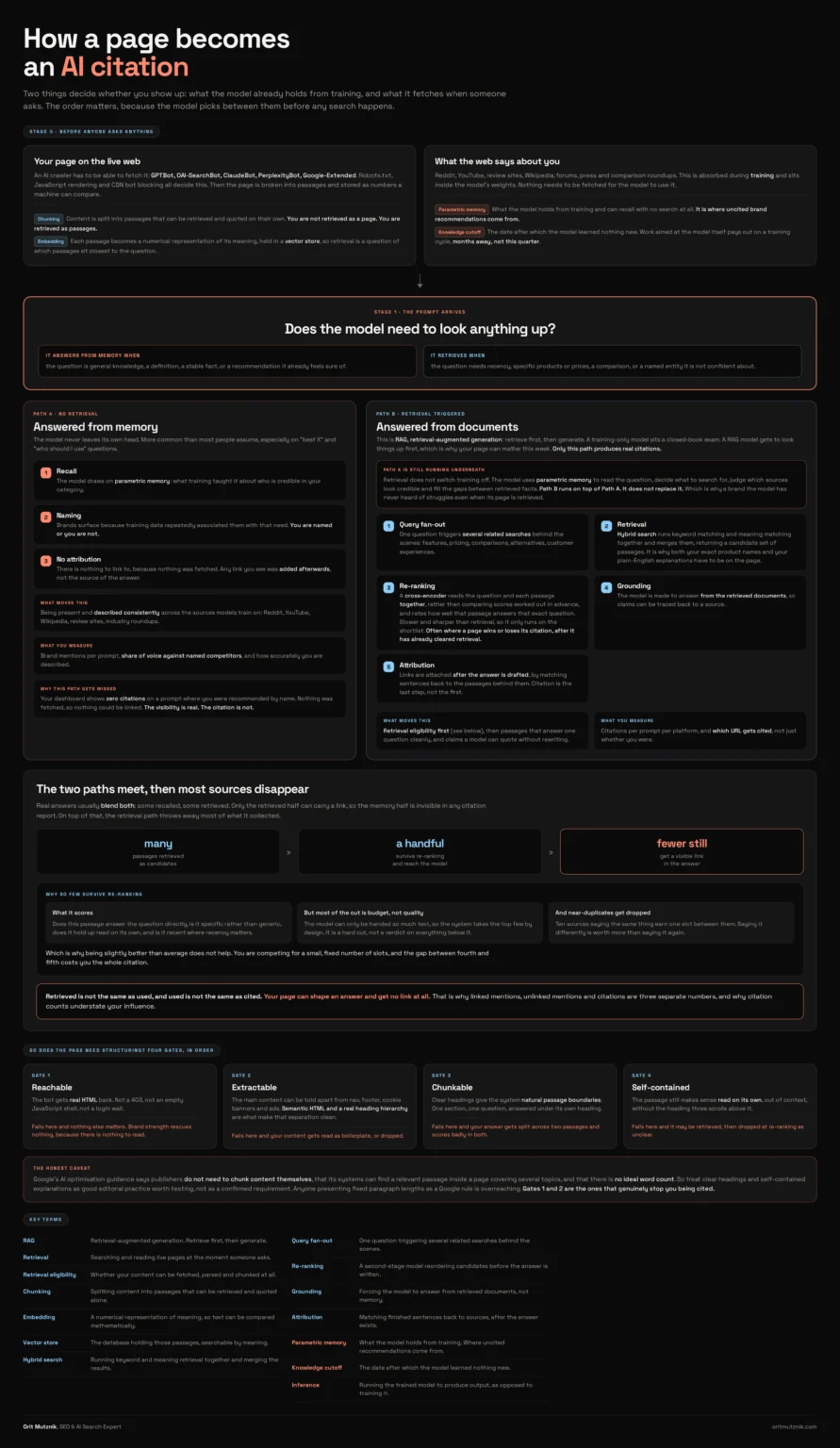
If you take one thing from it: Retrieved, used and cited are three different things, so a page can shape an answer and still get no link. Track linked mentions, unlinked mentions and citations as three separate numbers.
AI search FAQs
What is the difference between SEO, AEO, GEO and LLMO?
They describe different outcomes within one discipline. SEO is about being findable in a ranked list, AEO about being usable when a system answers a question directly, GEO about appearing inside a generated response and LLMO about how the model understands your brand in the first place. The tactics behind them overlap almost completely: Digital PR, offsite mentions, community presence, third-party listicles, original data, entity consistency and clean crawlable pages, plus a small set of genuinely new things such as llms.txt and the agent protocols. All 4 depend on the same foundation, because content has to be crawlable, retrievable and credible before any of them can happen. The full argument is in AI Search Optimisation 101.
Do I need to learn all of these terms?
No. The ones that change decisions are retrieval, query fan-out, client-side rendering, citation drift and the difference between a mention and a citation. The rest are useful for reading other people’s work without being misled, which is a real benefit and a smaller one.
Which AI search tool should I start with?
Whichever one you will actually run every month, because the trend line is the point and a stable prompt set matters more than the platform. Before buying anything, read your server logs. No visibility tool will tell you a crawler is getting a 403 and the logs will.
Why do different AI visibility tools give different numbers for the same brand?
Because they use different methods. Some query live assistants, some sample each prompt many times, some infer from clickstream panels and the platforms themselves return different answers run to run. Two tools disagreeing usually means both are correct about different things, which is why methodology disclosure matters more than the number itself.
Is this glossary going to date quickly?
Parts of it will. The concepts underneath, retrieval, rendering, entities and evidence, have been stable for years and will outlast every acronym in here. Tool names and protocol maturity are what I expect to be revising and I will.
Work with me on AI search
Knowing the vocabulary is the easy part. If you want to know which of these terms is currently costing you money - crawlers that cannot reach the pages that matter, an AI answer describing your brand wrongly, or a visibility number nobody can defend - tell me what you are seeing and I will tell you whether it is worth fixing.