


Why these 15
These are my go-tos for the latest in AI search, or AEO, or GEO, or LLMO, or whatever we are calling it this month. Three reasons they made the list:
- The takes are strong: Thought provoking, challenging and logical, and every one of them cuts through the bs. Each of them has made me think, challenged me, or changed my mind about something, which is a higher bar than being interesting. This field produces an extraordinary volume of confident nonsense, so I have come to value the people who push back on it with an argument I can actually follow.
- They show their work: Knowledge, data and tools you can pick up and run yourself. You get a method you can repeat on your own site, and you can check whether it holds on your own data.
- They keep you current: I wrote about the best free AI search courses recently and I stand by all 3 of them, but a course is a fixed point in time and this field moves every quarter. Beyond a course, these are the people who will keep you up to date with the most recent developments and the methodologies that hold up.
If you are starting from scratch, read my AI search optimisation 101 guide first and keep the AI search glossary open in a tab, because a fair bit of what follows assumes you know what query fan-out and grounding mean.
In no particular order.
Suganthan Mohanadasan
Co-founder, Snippet Digital and Keyword Insights · suganthan.com · LinkedIn · X
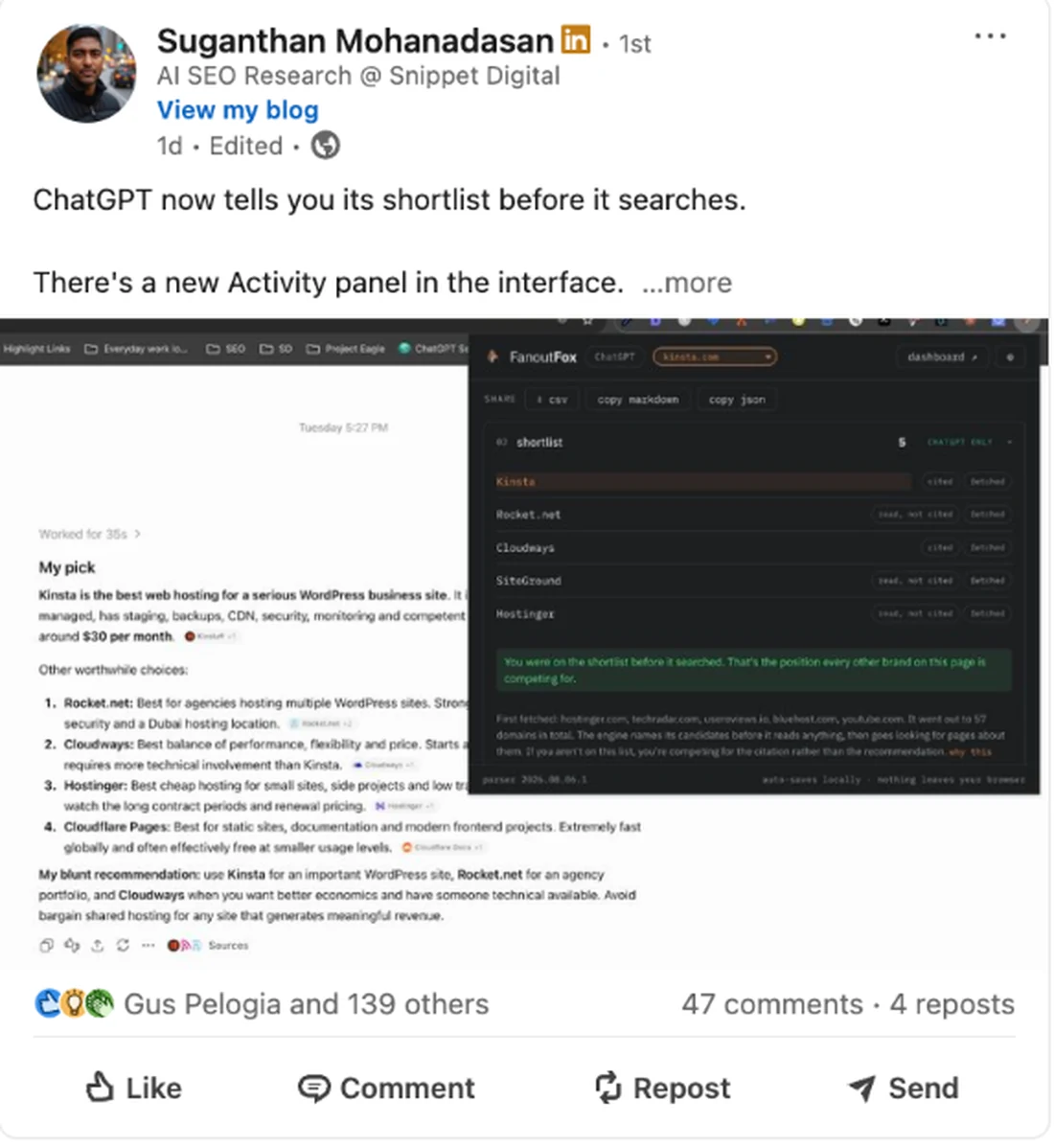
Based in Dubai, and one of the most prolific builders on this list. He has released BotsBrief, a free WordPress plugin for Open Knowledge Format bundles, and FanoutFox, a Chrome extension showing the fan-outs, aka sub-queries ChatGPT and Perplexity actually ran and which pages got fetched against which got cited. His free tools page has another 10. Follow him for method. He reads ChatGPT’s network traffic instead of guessing from its answers, which is how he found YouTube gets fetched constantly and cited almost never. OpenAI then changed how that data is exposed, so his own conclusion was that the specific percentages go stale quickly and the mechanism is the part worth learning.
His August work is the best thing I have read on how ChatGPT actually chooses: Reading the search query ChatGPT writes for itself, he found it naming competitor brands nobody typed before it fetches a single page, and brands that make it into that query reach the answer 68.9% of the time against 2.1% for brands that are only retrieved afterwards. The shortlist is written before the search runs, which reframes what you are actually competing for. He then caught ChatGPT rewriting those search calls into a compact pipe-delimited format, and one field in it explains what Reddit is actually doing inside these answers. Every brand line in that call ran a 30-day freshness window, the Reddit line got 365, and a local coffee query got 3,650, which reaches back to threads a decade old. Auditing a single conversation line by line, he found 84 of its 221 retrieved entries were Reddit threads, more than from any other source, and not one of them earned a citation. He is careful to call his conclusion an interpretation, because traffic alone cannot prove influence: The model fetches opinion about a shortlist it has already chosen, then hands the credit to vendor pages. He also built a free Common Crawl checker after finding that most sites blocking CCBot never made that call: They inherited a hosting default, and Common Crawl is pretraining data. OpenAI patches his findings almost as fast as he publishes them and he keeps building anyway. Not all heroes wear capes.
Aleyda Solis
Founder of Orainti, co-founder of Finchling · aleydasolis.com · SEOFOMO · AI Marketers · LinkedIn · X
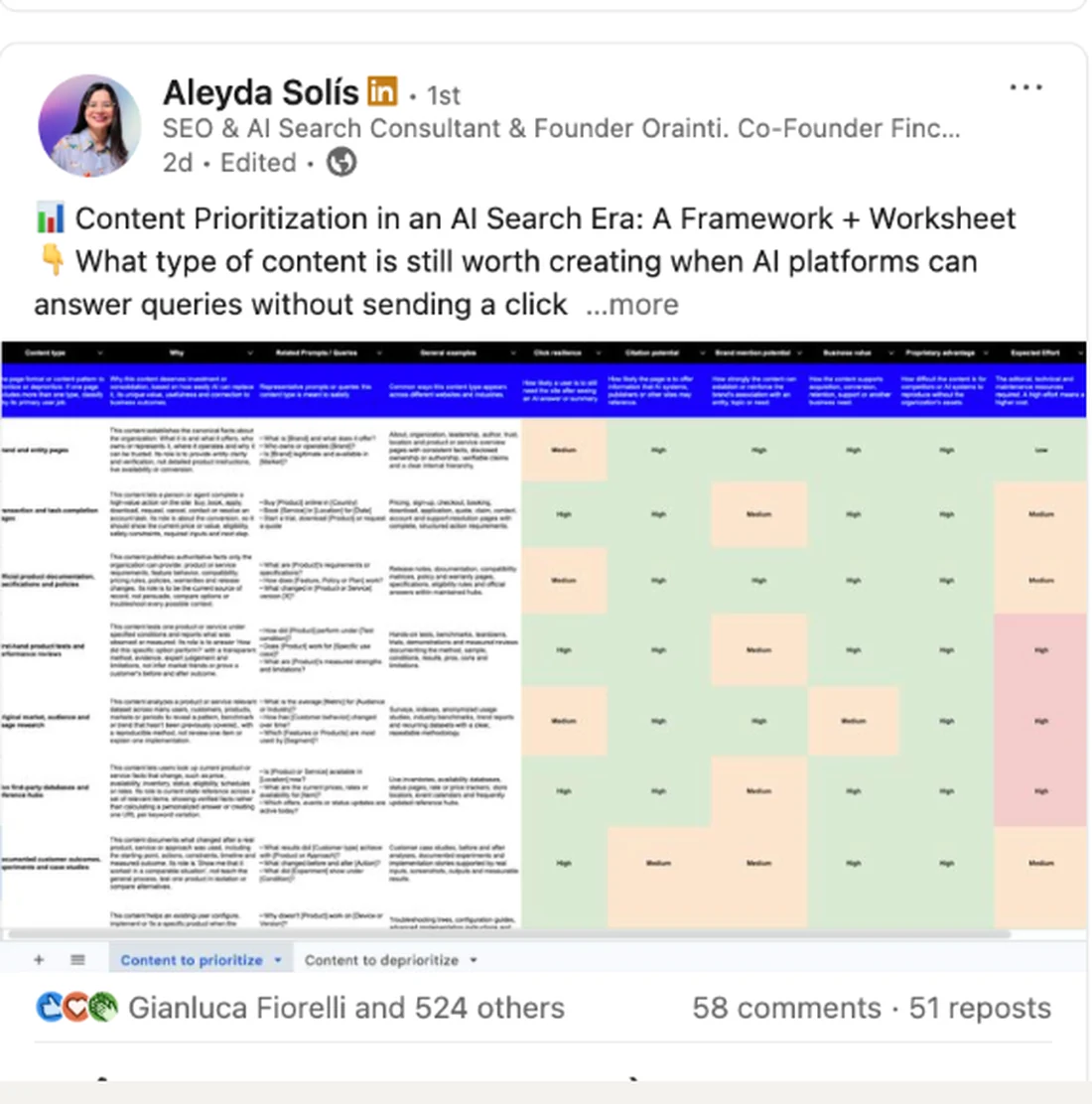
Aleyda is a veteran of this industry and needs no introduction, and she is certainly no stranger to lists like this one, but she is very much worthy of mine. She has given more away for free than anyone else in search, and she was doing it years before giving things away became a positioning strategy. She writes 2 weekly newsletters, SEOFOMO for SEO and AI search and AI Marketers for AI in marketing more broadly, and both are free, as are LearningSEO.io and LearningAIsearch.com, and she has since co-founded Finchling, a tool for spotting reactive PR opportunities. Follow her for original research. The conclusion I keep coming back to is from her citation study, that most of your citation surface sits on somebody else’s site, which makes digital PR and third-party presence matter more than your own content calendar. She also made the point that everyone blaming AI Overviews for the organic click collapse has missed text ads tripling their share of the clicks.
Dan Petrovic
Managing Director, DEJAN · dejan.ai · LinkedIn · X
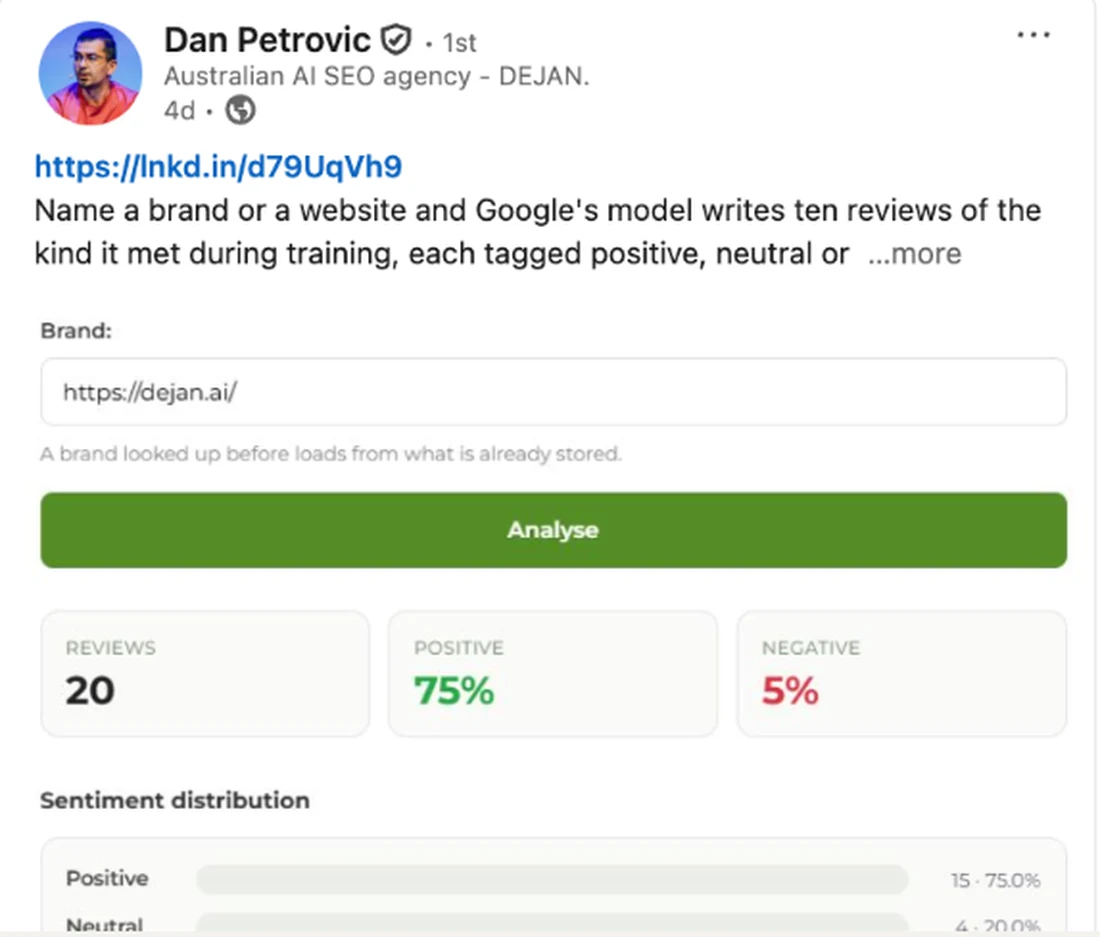
The closest thing this field has to a working research lab. He runs more than 25 free tools, including a grounding snippet extractor, and the index has fallen behind what he has actually shipped, and he trains his own models to build them. Follow him for research nobody else is attempting. He publishes monthly: 2.9 million brands ranked by how embedded they are in Gemini’s memory, 365,920 fan-out queries across three engines, and a finding that Gemini picks whichever page it reads first 92% of the time. He is also happy to take a scalpel to consensus, as he did showing OpenAI rejects Reddit almost every time, so the Reddit effect is a search artefact. The piece that most challenged my thinking is his work on extractive summarisation: Google passes Gemini extracted fragments, never the whole page, which means retrieval and scoring both happen at passage level. Optimise the page as a single unit and you never find out which passages are actually being pulled. This summer has been his most technical stretch yet, and the most quotable result is also the simplest. He counted crawler hits in his own server logs over 20 days and got 1,150 fetches of robots.txt against 4 of llms.txt, which is worth having to hand the next time somebody sells you a file. He took Chrome apart to show how Gemini actually receives a page: The browser serialises the rendered, signed-in DOM the user is looking at, so what reaches the model is the page as Chrome drew it. And he fitted a linear map from open-weight Gemma embeddings onto Gemini’s proprietary ones at 0.831 cosine, so you can approximate Gemini’s retrieval geometry on a laptop. He also cut one of his own headline results from 15.2% to 4.6% once he worked out most of it was the training schedule, which is the best reason to trust the rest of his numbers. He gives the models and the tooling away, which for a commercial agency is genuinely unusual.
Lily Ray
VP of SEO and AI Search at Amsive, founder of Algorythmic · lilyray.nyc · Substack · LinkedIn · X
Another list-veteran who needs no intro, and who has made it into yet another list (the good kind this time). She launched Algorythmic in April 2026, and she built a free LLM Content Visibility Scanner that flags client-side rendering dependence, on the premise that LLM crawlers do not execute JavaScript, so anything injected client-side is invisible to them. Follow her for core update forensics applied to AI search. Her sharpest piece argues your GEO strategy might be destroying your SEO, with traffic charts for five named tactics including scaled AI content and self-serving listicles. Her study of sites hit by the January 2026 update found them losing organic traffic and AI citations together, with one exception worth sitting with: Perplexity barely moved, which suggests it is not retrieving from the same index as everyone else. She has since found that calling yourself the best can hand the recommendation to your competitors. Across 100 B2B queries, when a brand’s own listicle ranking itself first got cited in AI Overviews, the brand was left out of the actual recommendation 69% of the time, and the rivals named inside its own post were recommended instead.
Kevin Indig
Growth advisor and author of Growth Memo · kevin-indig.com · Substack · LinkedIn · X
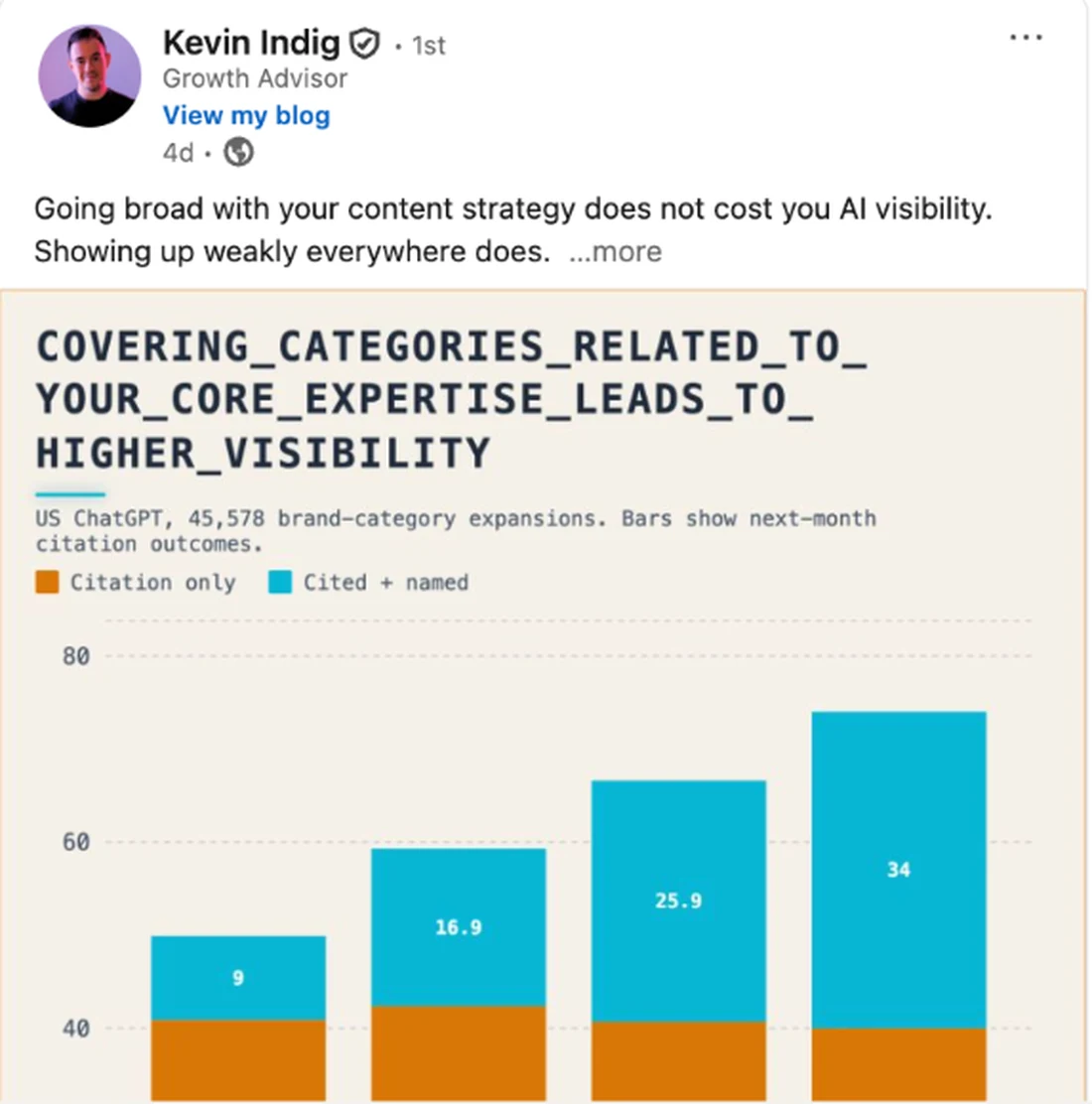
Previously running SEO and growth at Shopify, G2 and Atlassian, now writing Growth Memo for people who have to defend a number in a board meeting. Follow him for the largest datasets in AI search research. The Consensus Gap produced the number I reach for whenever somebody sells a single blended AI visibility score, which is that 91% of cited URLs appear on only one platform. His agent research ran 1,500 agent tasks and showed where B2B sites break, with pricing pages failing most and review sites filling the gap when they do. His topical authority study is the one I would build a plan around: Across 1,094 categories and 600,000 citations, only 15.2% of categories have a clear owner, and 89.3% of AI search demand sits in categories nobody owns yet, but once a brand does take a category it holds first place in 90.4% of the following months, which makes a category cheap to claim now and expensive to take back later. He also publishes a twice-yearly state of the industry, which is the fastest way to catch up if you have had your head down for six months.
Glenn Gabe
Founder, G-Squared Interactive · gsqi.com · LinkedIn · X
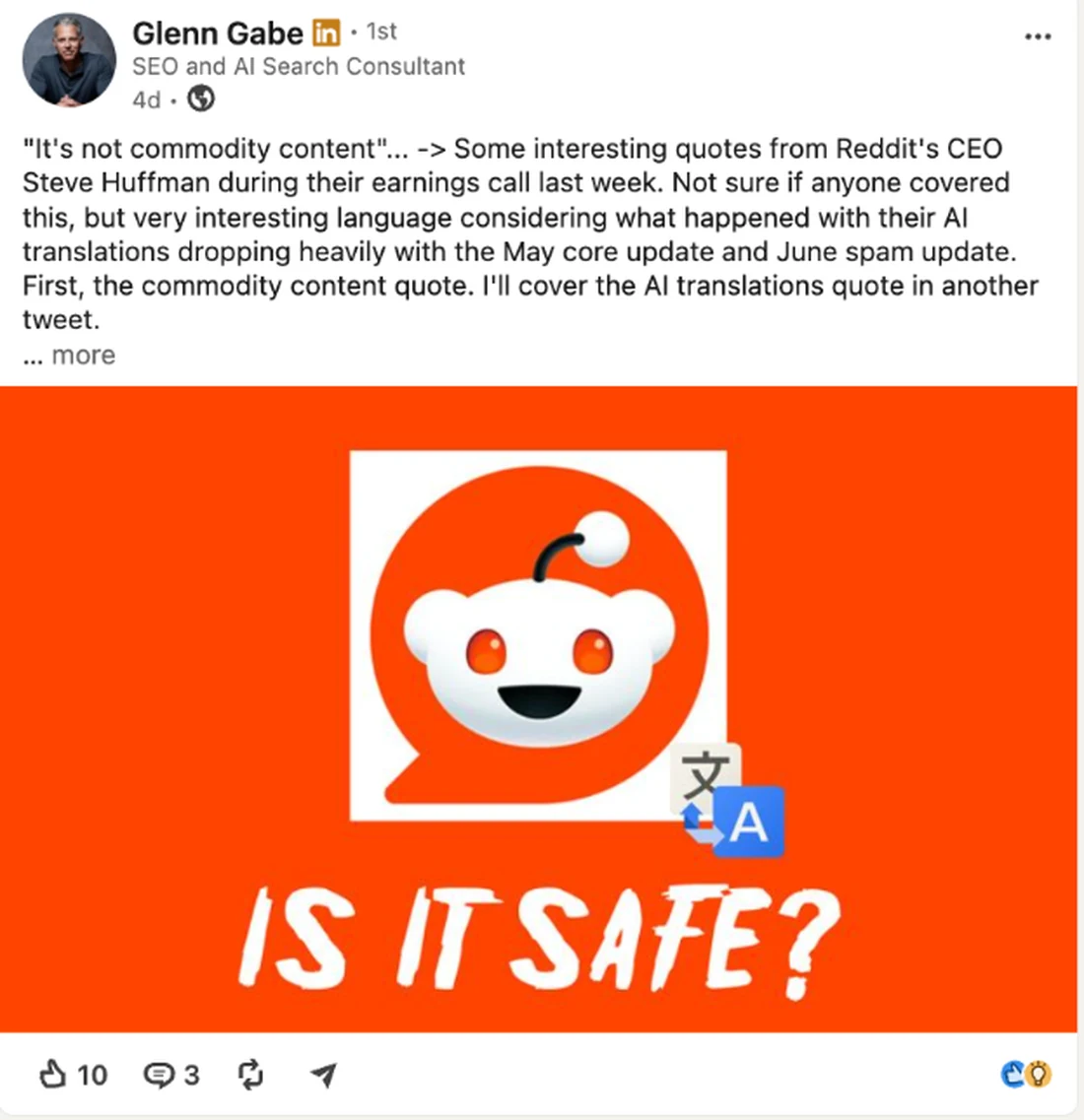
The most forensic algorithm analyst working, publishing case-study breakdowns of every broad core update since 2006. Follow him for takes you will not get anywhere else, worked out from his own tracking of real sites. He coined “Mt. AI” for the spike-then-collapse shape a site gets when it games AI visibility, and he tracked Reddit’s machine-translated pages for over a year before they finally dropped, which is the kind of patience this work needs and almost nobody has. His preview controls case study, showing nosnippet and max-snippet pulling content back out of AI Overviews, is the most operationally useful thing on his site. His most unsettling case study this year follows a site that was surging in ChatGPT while dead in Google. Bing then deindexed it outright, and the ChatGPT citations carried on climbing past 464,000, including articles published after the deindexing, which leaves OpenAI either running an index of its own or grounding on sources it has never disclosed. He also talks the findings through on his podcast, SEO From The Front Lines, if you would rather listen than read.
Metehan Yeşilyurt
GEO Researcher, Peec AI · metehan.ai · Substack · LinkedIn · X
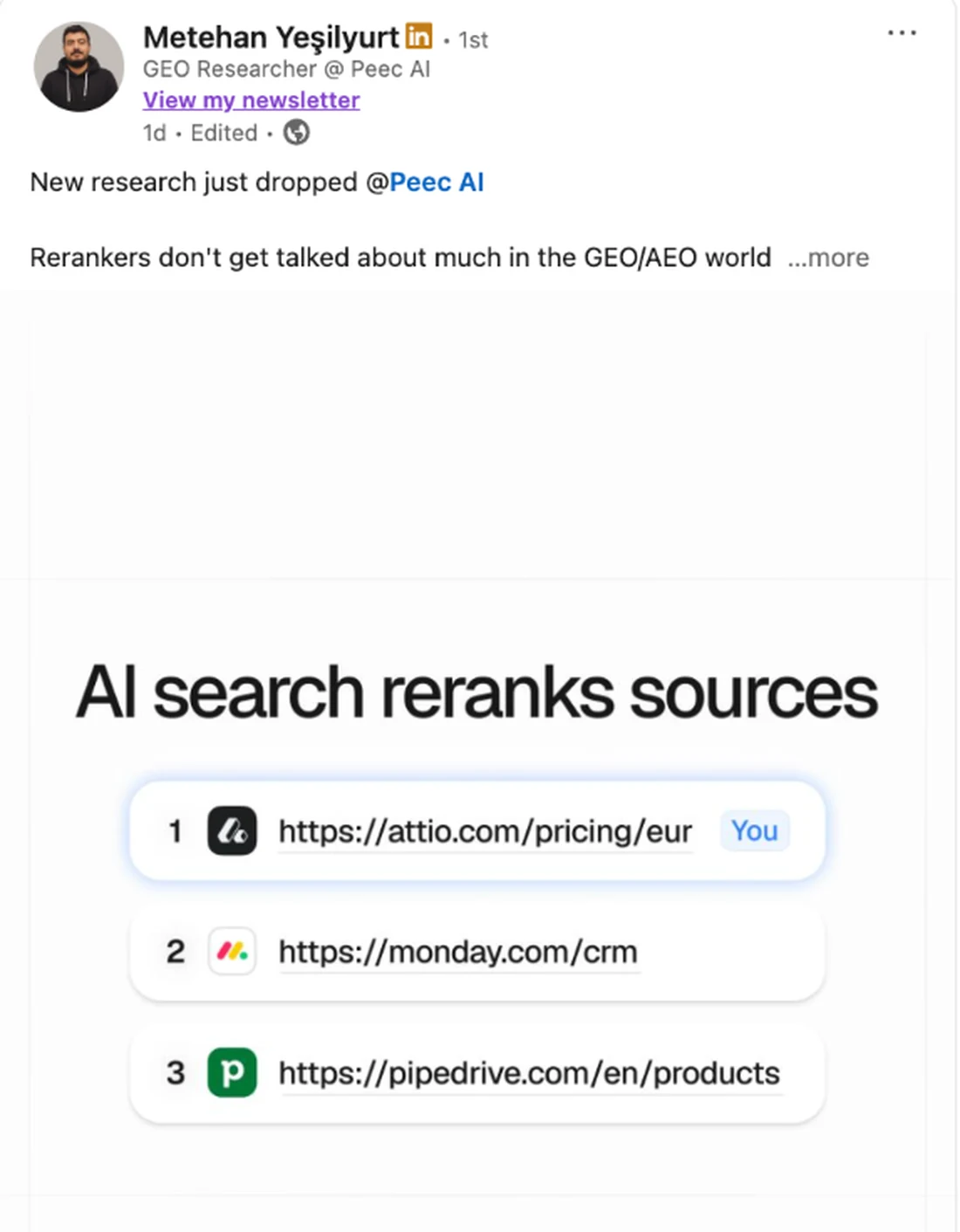
Follow him for reverse-engineering. He runs controlled experiments and network traffic analysis on AI search systems, then publishes what he finds. With Tomek Rudzki he analysed 5 million fan-out queries and found ChatGPT injecting commercial words nobody typed, “best” into 15.33% of expansions, which explains why listicles keep winning. His Reddit study covered 64.77 million citations and found that in Sweden, Norway, Poland and Spain most Reddit citations point at machine-translated English. His tools page lists roughly 69 free utilities and his GitHub holds the Screaming Frog scripts and MCP servers. His reranker test is the cheapest thing on this page to act on. He scored the same 2 passages through 12 open-source rerankers: A well-written, clearly on-topic product description scored 0.0019% on one of them, and a single sentence that answered the query directly scored 99.8%. Being about the topic and answering the question are separate axes, and only one of them gets you retrieved. He also argues, at length and against most of this list, that AEO genuinely is a different job from SEO, and he publishes the underlying datasets so you can argue back using his own numbers.
Harpreet Singh Chatha
Founder, Harps Digital · harpsdigital.com · LinkedIn · X
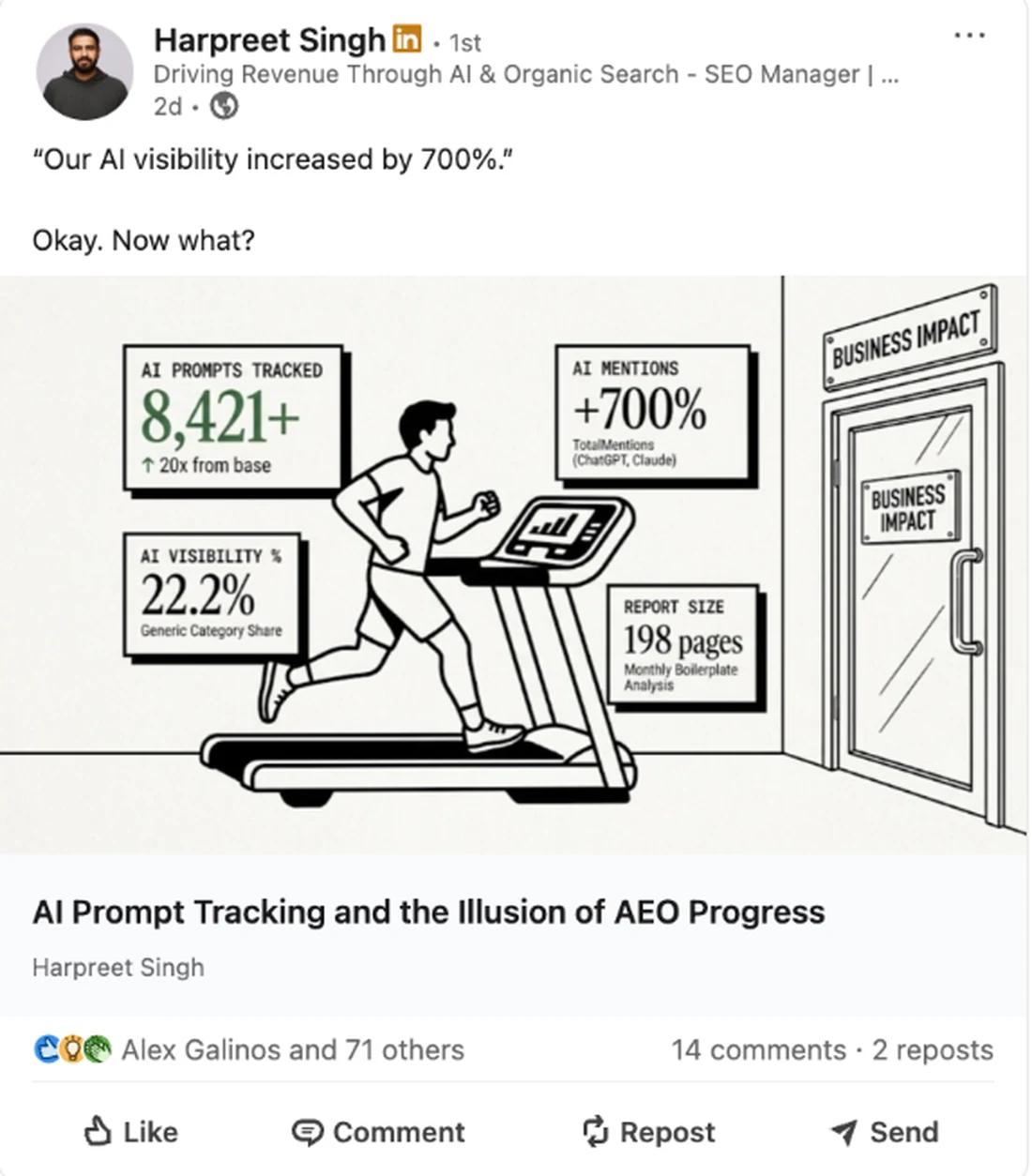
The industry’s most effective challenger, and its most useful critic. He bought a $5 press release announcing that an agency he had invented was now offering GEO services, watched the claim surface in AI Overviews and ChatGPT, and used that to argue the whole service line is SEO with a new invoice. Follow him for anti-hype experiments you can run yourself. His position is that 70% to 80% of the work is just SEO, and that the acronyms exist because SEO has a reputation problem in the boardroom. He built the free AEO Leaderboard, which tracks 86 brands across 17 industries on AI citations against organic traffic, runs the SEO Espresso newsletter, and publishes reproducible methods like his salience scores walkthrough. Everything he builds is free.
Mark Williams-Cook
Director at Candour, founder of AlsoAsked · markwilliamscook.com · Substack · LinkedIn · Bluesky
He goes after AI search misconceptions, and his method is to build the counter-example. cats.txt is a satirical standard he invented declaring your office cats, their job titles and their purring frequency, which then passed all 4 proofs people offer for llms.txt: Bots fetched it, Google indexed it, ChatGPT cited details found nowhere else, and ChatGPT went on to recommend it as a ranking tactic. He did the same to schema with a fictional duck t-shirt company. Follow him for free tools and experiments that test what everyone else assumes. QueryClassifier sorts queries by intent using a model trained on the leaked Google data, and QueryFan captures the Google queries ChatGPT and Gemini fire in the background. The follow-up is better than the prank itself: ChatGPT first recommended cats.txt as a real ranking tactic, then reversed and called it satire once the joke had circulated, same file, same prompt, opposite answer. He writes the weekly Core Updates newsletter out of Candour, and his hand-drawn illustrations are hilarious and reliably break the algorithm.
Rodrigo Stockebrand
AI Search Explorer, O’Reilly author, former Head of SEO at NASA · LLM Candy · LinkedIn · X
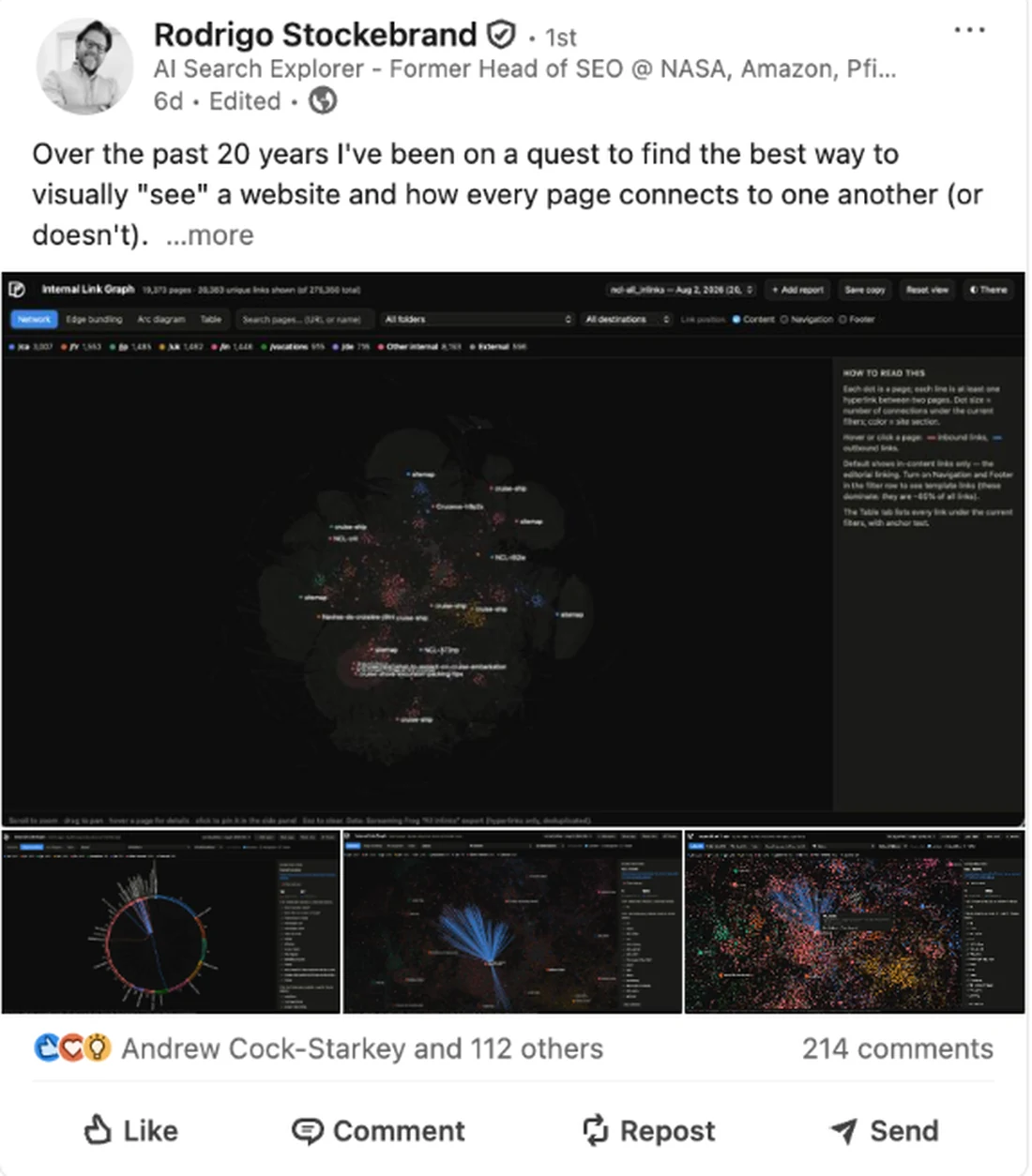
Former Head of SEO at NASA, Amazon, Pfizer and Univision, and author of Answer Engine Optimization, published by O’Reilly in 2026 (!). Follow him for reference material that is a pleasure to use. His tool LLM Candy builds visually stunning topical maps for SEO and AEO, and it does the thing he is best at, which is making an abstract idea concrete enough to act on. It started free and has since moved to paid. The book is worth the time for its five-gate RAG framework and its case for optimising at passage level and tracking citations in place of rankings.
Ben Wills
Founder and engineer, OppAlerts · oppalerts.com · LinkedIn · X · GitHub
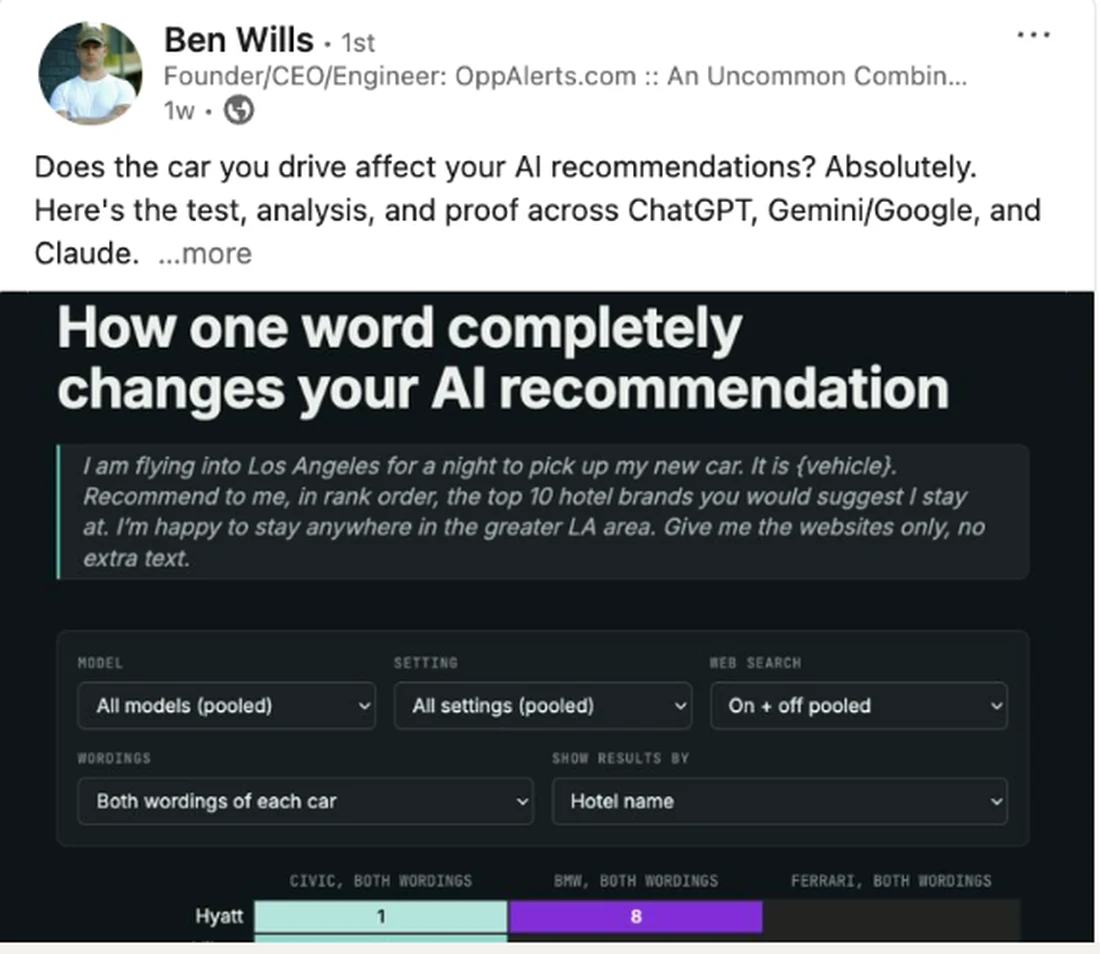
New to my list, and working with serious numbers. He has been in SEO since 2001, with about ten years in the middle spent as an engineer building his own crawlers and parsers, which is why he can run studies at a size most people cannot afford. Follow him for correlation studies with unusually honest caveats. His AI Search Visibility and LLM Ranking Factors report ran 403,000 prompts across 100 industries and 10 models, and he is upfront about how little of the variance any single signal explains. The 100 industry pages are free to read. My favourite thing he has published is the one-word study: The same hotel prompt run 1,374 times, changing only the car the traveller is picking up. A used Honda Civic gets Marriott recommended 98.7% of the time, and a Ferrari drops it to 10.4%. He has since traced how Claude turns Brave results into citations across 1,100 responses, and found that 55.7% of the text Claude cites appears only in the fetched page, never in the search snippet. Optimise the snippet alone and you are competing for half the surface.
Eli Schwartz
Author of Product-Led SEO, growth advisor · productledseo.com · LinkedIn · X
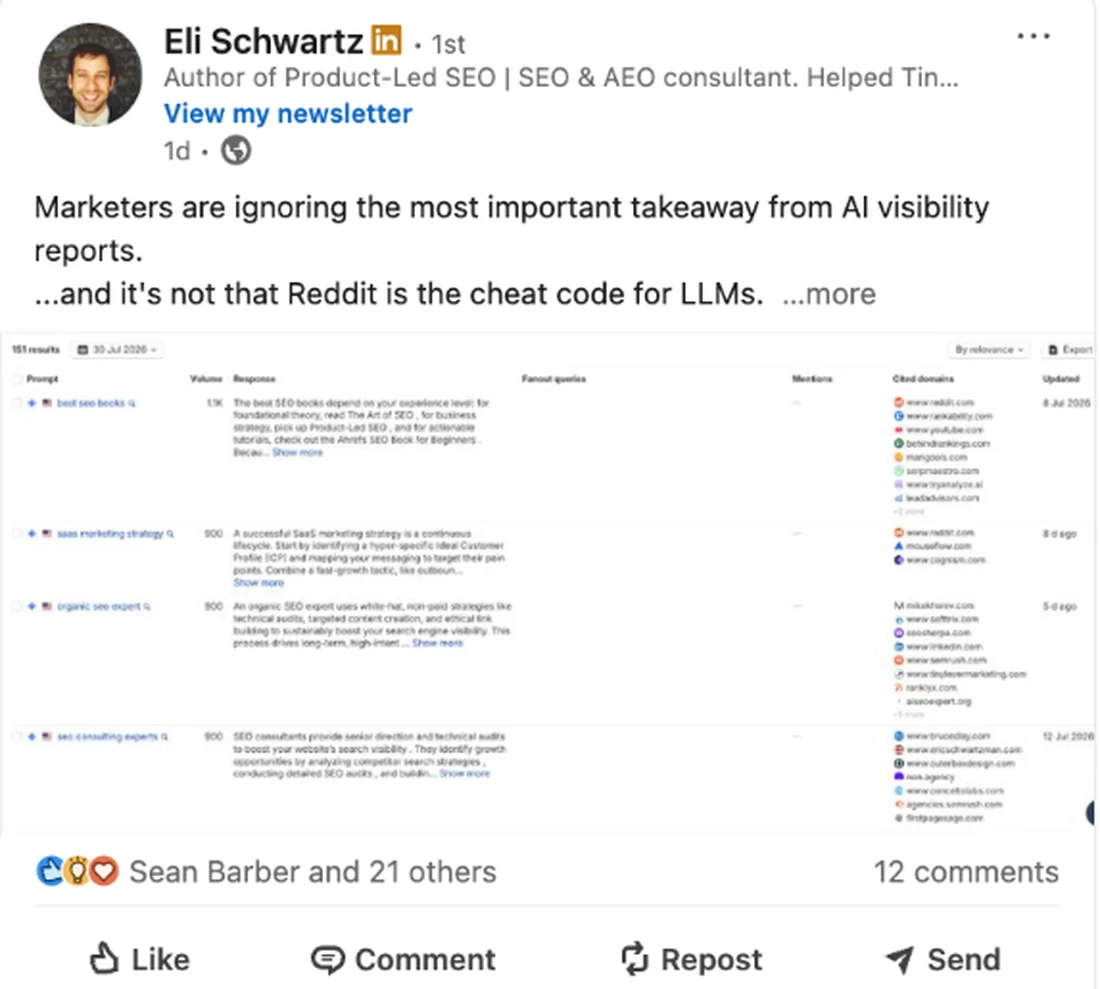
Best known for Product-Led SEO, and an advisor for years now to companies including Coinbase, Tinder and Anthropic. Follow him for the strategic argument, which is where he is strongest. He is the most articulate sceptic on AEO, and his AEO is not SEO 2.0 argument is worth reading even where you disagree with it, which I partly do. His best piece this year argues AEO hires should be product managers, because SEO got bolted onto marketing org charts as a channel and the in-house role has become “an SEO suggestion box with a title”. He is right about the mechanism, and I would add that all the brand strength in the world does nothing if your crawler gets a 403. He has since hardened that position, and on how to measure AEO he argues the only defensible metric is revenue, and that every team building an AEO-specific measurement framework ends up with a vanity number. He has also renamed his newsletter to cover AEO alongside SEO, which tells you where he thinks this is heading.
Ray Martinez
VP of SEO, Archer Education · raymartinezseo.com · LinkedIn · X
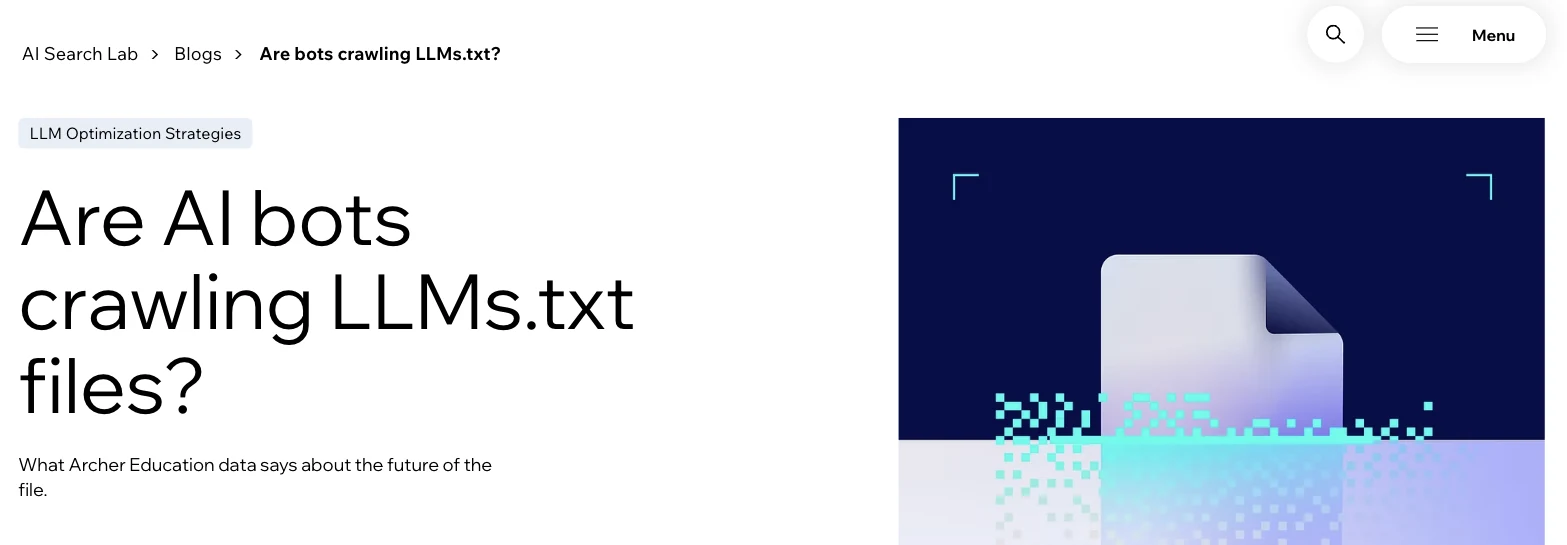
He works in higher education, and he is the one who inspired me to put llms.txt to the test. Follow him for server log evidence. His llms.txt research, later published through Wix Studio’s AI Search Lab, is the strongest counterweight to the case that nothing fetches these files, with OpenAI’s bot accounting for 94% of the hits. He then had the pleasure of watching ChatGPT cite his own research back at him. His Search Engine Land piece treats schema as infrastructure you use to find entity gaps, and his SEO Week talk carries the number I keep repeating to clients: A page holding the same ranking now loses roughly 25% of its clicks. He has since published the other half of that picture in a higher education guide, where Archer’s own funnel shows leads converting to applications at 56%, up from 44% in 2024, so the arrivals are fewer and better qualified.
Britney Muller
AI consultant and educator, founder of Orange Labs · britneymuller.com · LinkedIn · X
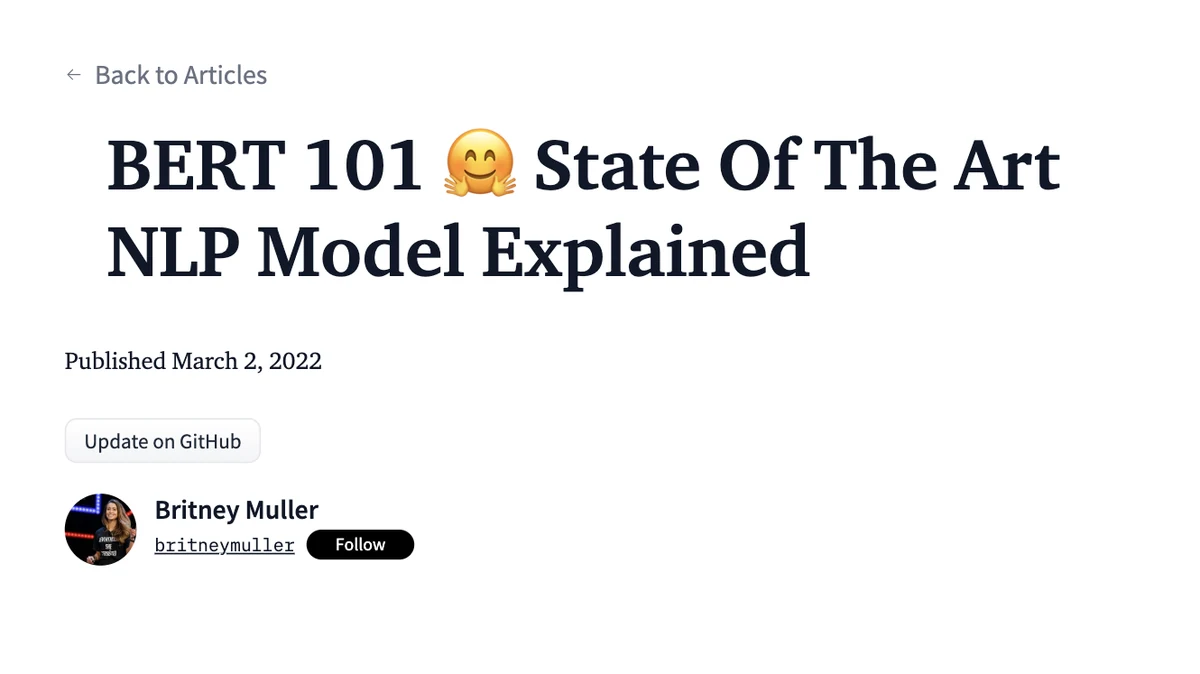
She teaches machine learning to marketers, and she is who I point people to when they need the layer underneath the tactics. Follow her for the clearest explanations of how these systems actually work. Her explaining is visual and plain, and she will walk you through how RAG retrieves a passage, what an embedding is doing, and how transformers represent text, without hand-waving and without pretending it is simpler than it is. Her BERT 101 explainer is how a good part of this industry learned transformers without ever saying so, and her Colab notebooks were published so non-technical marketers could run them without breaking anything. She now teaches through Maven and her Orange Labs community. Her Digital Day Out keynote in August is the best short answer I have heard to what these models actually are: Probabilistic averaging machines, which she demonstrates by asking image generators for a left-handed golfer or a wine glass filled to the brim and watching them fail, because those are rare in the training data. Once you understand retrieval properly, most of the advice out there sorts itself into obviously true or obviously invented.
David McSweeney
Founder, QueryBurst · queryburst.com · LinkedIn · X
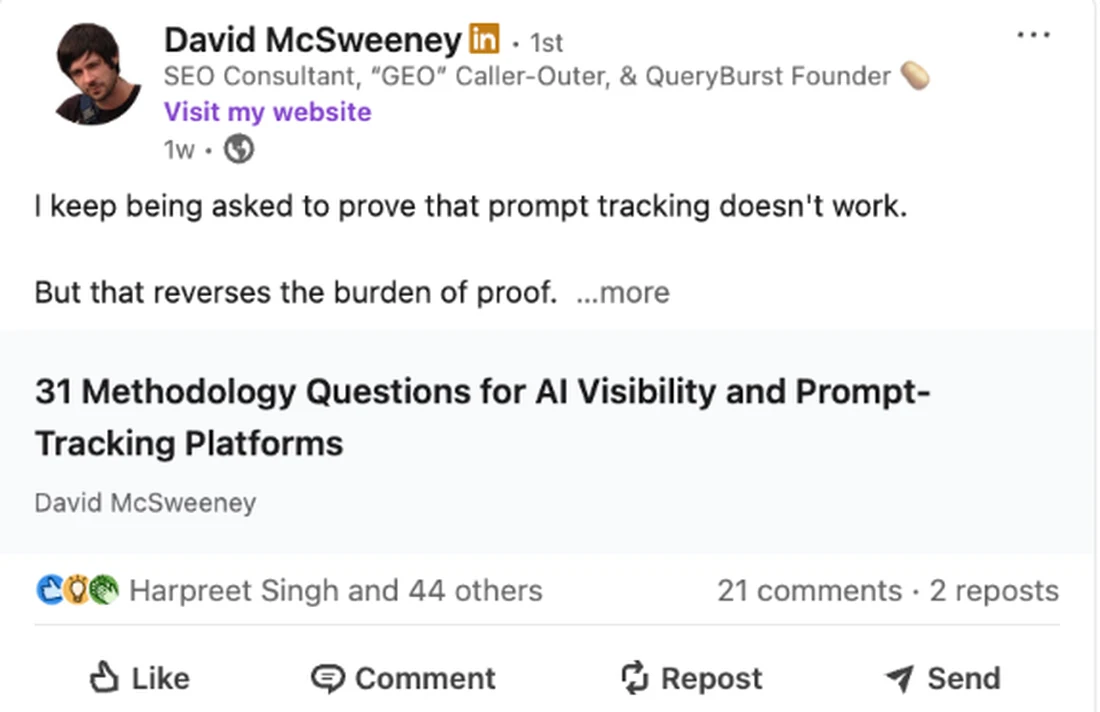
New on my radar, and a welcome addition. He builds in public from Perth in Scotland, and his LinkedIn headline reads “SEO Consultant, ‘GEO’ Caller-Outer”, which tells you most of what you need to know. Follow him for the case against GEO, argued properly. His post The Great GEO Grift is the most shared version of the argument that most promoted GEO tactics have been standard practice for a decade, and that prompt tracking runs on sample sizes too small to mean anything. He then built a product that deliberately refuses to do prompt tracking, and put a free grounding pipeline demo on the site where you paste your own URL and watch query classification, embedding ranking and passage extraction happen in front of you. It is the single best thing to send someone who has never seen retrieval work.
More no bs AI search coming
Follow these people for no bs AI search optimisation expertise, tools and tips you can actually use. Speaking of no bs, I will keep publishing on this in the same spirit as the people above, which means what I tested, what the data actually said, and what did not work. Follow me on LinkedIn or X so you catch it.
AI search experts FAQs
Who are the best AI search experts to follow in 2026?
There is no single ranking, because they are good at different things, so pick by the job you need doing. For original research at scale, follow Kevin Indig, Ben Wills, Metehan Yeşilyurt and Aleyda Solis. For evidence-led scepticism, follow Mark Williams-Cook, Eli Schwartz and David McSweeney. For platform behaviour and algorithm forensics, follow Glenn Gabe and Lily Ray. For the underlying mechanics, follow Britney Muller. Most people are best served by one from each group.
Are AI search courses still worth taking?
Yes, as a foundation, and I have rounded up the best free AI search courses if you want somewhere to start. A course gives you a structured order somebody has tested on real learners, which is worth a lot in a field only 3 years old. What it cannot give you is currency, because citation patterns and platform behaviour change faster than anyone can re-record a video. Take a course for the fundamentals, then follow people for what changed since.
How do I tell a credible AI search expert from a hype account?
Watch out for AI slop, and follow your own logic. A great deal of what gets published on AI search now is generated, unverified and confidently wrong, and it travels because it sounds plausible. The tells have not really changed: No method, no sample size, no time window, and a conclusion arriving with nothing behind it. Ask whether the claim would need a test to prove it, and whether anybody actually ran one. Be especially wary of guaranteed citations, ranking factor lists for ChatGPT, and single screenshots offered as evidence, because none of those survive scrutiny. Then run it on your own site, because if a finding does not hold up against your own data, your data wins.
Is AEO or GEO a different job from SEO?
Mostly no. Everything that benefits your SEO will also benefit your visibility in LLMs, so the foundations have not moved. What has changed is the weighting: Offsite work and digital PR carry far more of the load now, because most of your citation surface sits on other people’s sites and not on yours. A handful of practices are genuinely new, like agentic protocols and llms.txt, which had no real SEO equivalent. All of it still sits under the wider umbrella of search everywhere optimisation, which is the framing I use and unpack in my AI search optimisation 101 guide.
Work with me on AI search
Not sure where to start with AI search optimisation, and how not to harm your SEO in the process? Talk to me.