


The AI Search Conversation Started Without You
If you’ve been time travelling, or just came back from a long career break, this one is for you. I wrote it to reflect on the tectonic shift the SEO industry and the people in it have been through over the past 4 years. An SEO’s brief history of time, if you will.
So here is how we got from A to B and beyond, what you need to know to work on organic search today and every source that helped me learn it and move into AI search without losing sight of the SEO best practices that still carry most of the traffic. If you would rather learn this in a structured hour, I have reviewed the best free AI search courses separately.
Open LinkedIn today and people are debating citation tracking, prompt monitoring, query fan-out and agent readiness. Some of it is useful, some of it is AI slop and almost all of it assumes you already know how we got here.
I keep meeting marketers and SEOs who are still working out when SEO became AEO (Answer Engine Optimisation), why GEO (Generative Engine Optimisation) appeared and whether their brand now needs four separate strategies. They walked into a conversation that had started halfway through and nobody went back to the beginning for them. So here is the beginning.
TL;DR: From SEO to AI search in 90 seconds
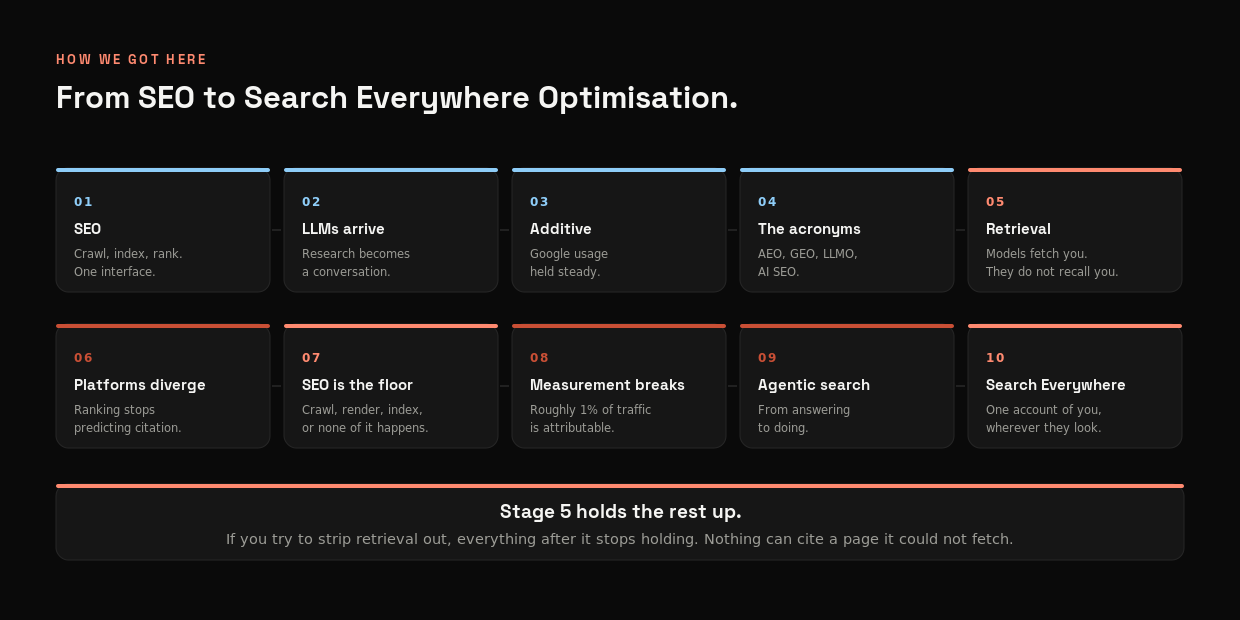
- It started with SEO: Google crawled, indexed and ranked. One interface, one outcome, one place to compete. That model still exists and still carries most of the traffic.
- Then LLMs became discovery surfaces: ChatGPT, Claude, Gemini and Perplexity turned research into conversation and Google answered from inside its own results with AI Overviews and AI Mode.
- Surprisingly, LLM usage has been added on top of traditional search, not replaced it. Semrush tracked 260 billion rows of clickstream data and found Google usage held steady after people started using ChatGPT, so the habit grew.
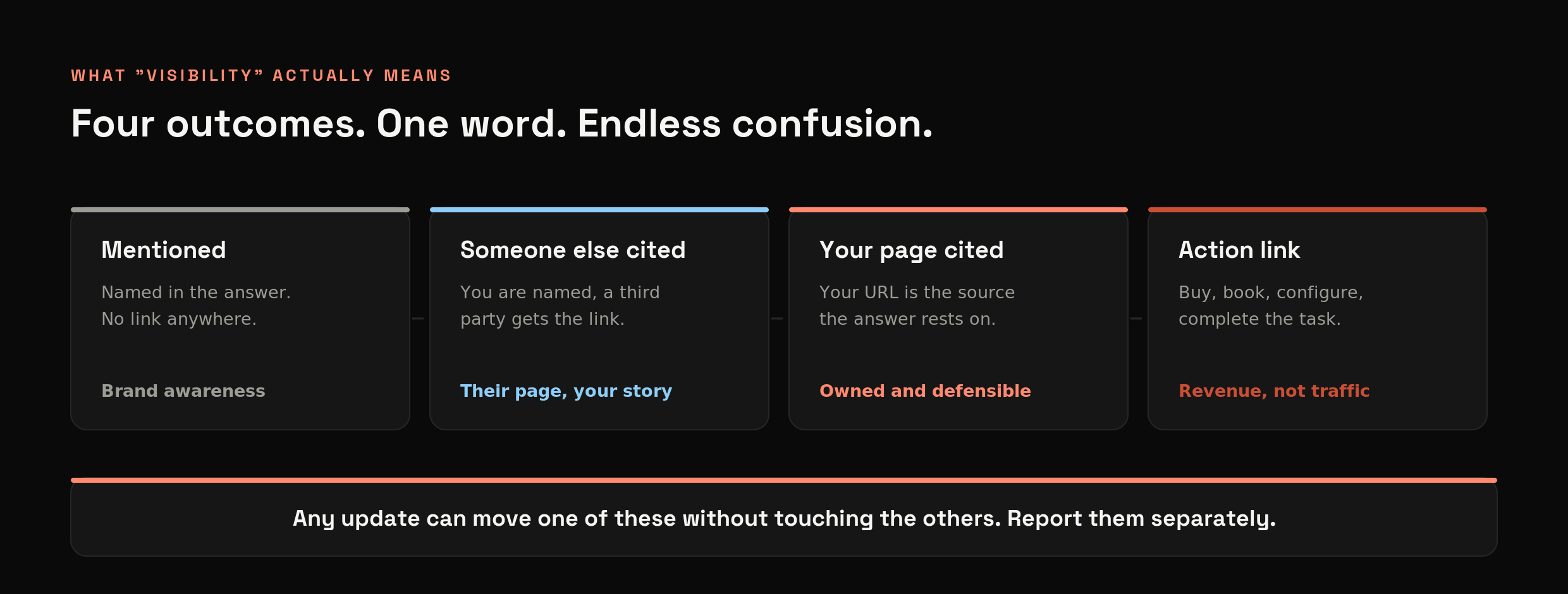
- The acronyms arrived: AEO, GEO, LLMO (Large Language Model Optimisation) and AI SEO, describing 4 outcomes: A citation, a mention, a recommendation and a ranking.
- Retrieval turned out to be the mechanism: Models mostly don’t remember you, they fetch you. If a page can’t be crawled, rendered or retrieved, nothing downstream helps.
- Then the platforms stopped agreeing with each other: Ranking no longer predicts citation and the assistants barely share a source list. Each surface has to be measured on its own terms.
- Which makes SEO the true foundation of it all: Crawling, rendering and indexing decide whether any of it is possible. Client-side rendering is where most brands fall.
- Measurement broke: From what analytics can actually attribute, AI search is roughly 1% of all traffic, diverging massively by industry, from 0.25% to 2.80%. That’s a floor, because attribution leaks across apps and surfaces and even “AI bot traffic” is 3 different activities wearing one label.
- Then agentic search optimisation: Assistants went beyond answering and started doing: Comparing, configuring, booking, buying. Visibility became the start of the journey. Everything that decides whether you get cited happens after it.
- Which lands on Search Everywhere Optimisation: One consistent, well-supported account of your brand across every source these systems reach into and a site an agent can actually finish a task on.
How Did We Get Here? A Short History of AI Search
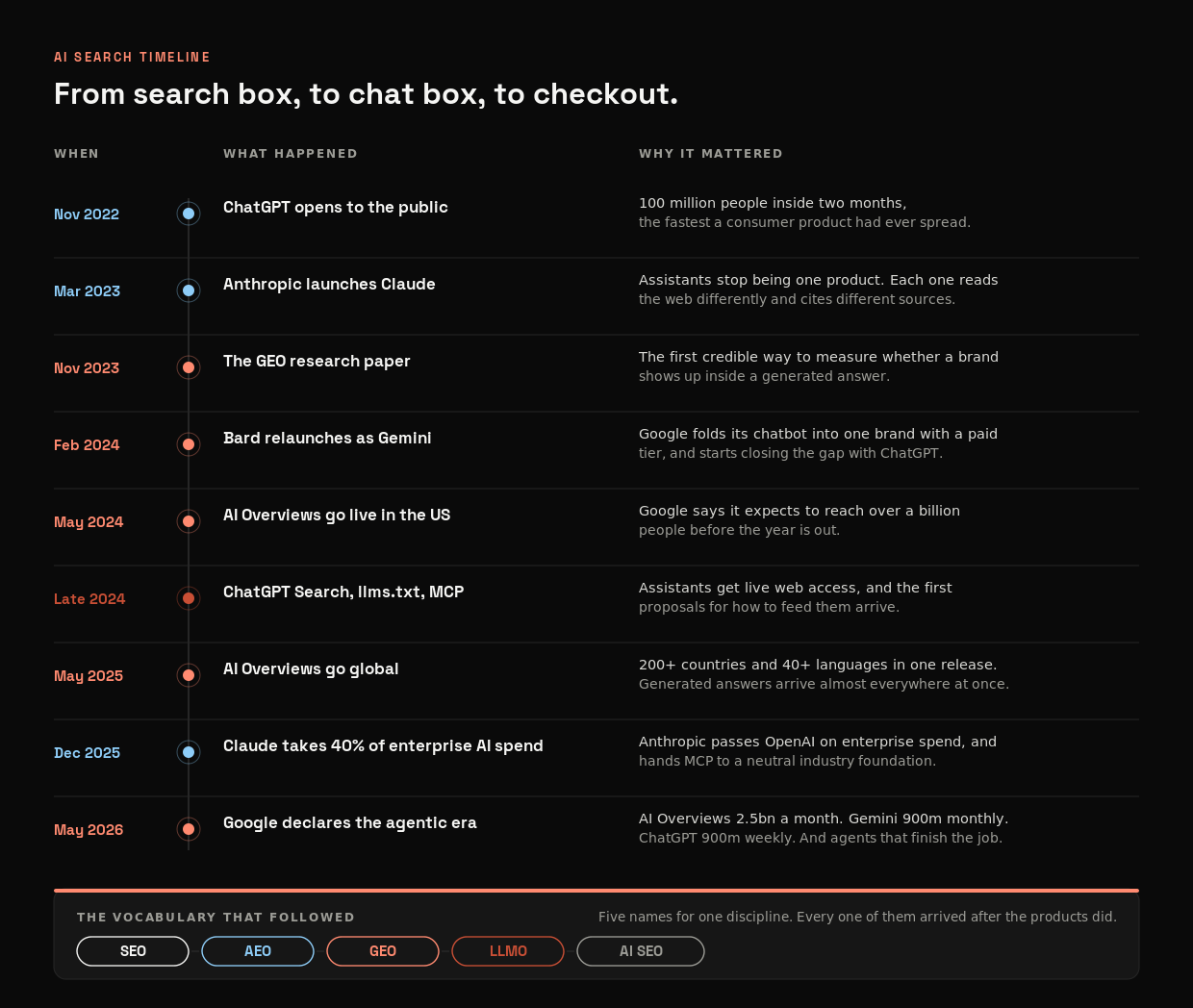
The rise of AI search gets framed as a move away from Google. That framing falls apart for these reasons:
- AI search lives inside Google, as well as outside it.
- People are adding these tools to their habits rather than swapping one for the other, per Semrush.
Semrush tested that directly and set it up the way you would want: 260 billion rows of clickstream data from US desktop users, Google sessions measured for 90 days either side of someone’s first ChatGPT session, against a control group who never touched it.
Google usage didn’t fall. There was no statistically significant change, with a slight increase on average, and the same held for people who had been using ChatGPT for 500 days. ChatGPT got added to the habit. Almost nobody dropped Google to make room for it.
That matters commercially, because a separate Semrush study found the average AI search visitor converted at 4.4 times the rate of the average organic visitor, which means the smaller number carries far more weight per visit.
Inside Google, traditional results still rank websites, products and local listings, AI Overviews generate a summary within those results and AI Mode handles longer questions and follow-ups. According to Google Search Central, both may use query fan-out, running several related searches across subtopics before composing an answer.
The second route is conversational discovery and every search engine now has one. ChatGPT searches the live web inside a conversation, Claude runs iterative searches and cites what it used, Perplexity puts web research and citations at the centre of the product and Gemini connects Google’s models with Search and the wider ecosystem. Google added AI Mode for longer questions and follow-ups and Microsoft shipped Copilot Search in Bing doing much the same job, folding a conversational answer, source links and follow-up prompts into one results page.
So the same behaviour is turning up everywhere at once, which is what the clickstream data is picking up. What changed is where people go first when a question is messy and half-formed and how many places they pass through before deciding.
SEO vs AEO vs GEO vs LLMO: What each acronym actually means
I’ve tried to pin down the differences between the 4 most popular acronyms, plus the catch-all people reach for when they’d rather not pick one. More exist and new ones arrive most months, but these seem to me like the ones sticking around for a while.
| Term | What it was trying to explain |
|---|---|
| SEO: Search Engine Optimisation | Helping search engines access, understand and surface content. |
| AEO: Answer Engine Optimisation | Helping answer-based systems use information when responding to questions. |
| GEO: Generative Engine Optimisation | Improving content or brand visibility within generated responses. |
| LLMO: Large Language Model Optimisation | Helping large-language-model systems understand and reference information. |
| AI SEO | A broad label for some combination of the work above. |
GEO gained momentum after researchers proposed a framework for measuring source visibility in GEO: Generative Engine Optimization, submitted in 2023 and later accepted at KDD 2024.
The industry invented these for a reason. It needed language for citations, mentions and recommendations, because none of those are rankings. Then vendors built reports around the words, agencies built service lines around the reports and the debate supplied the rest.
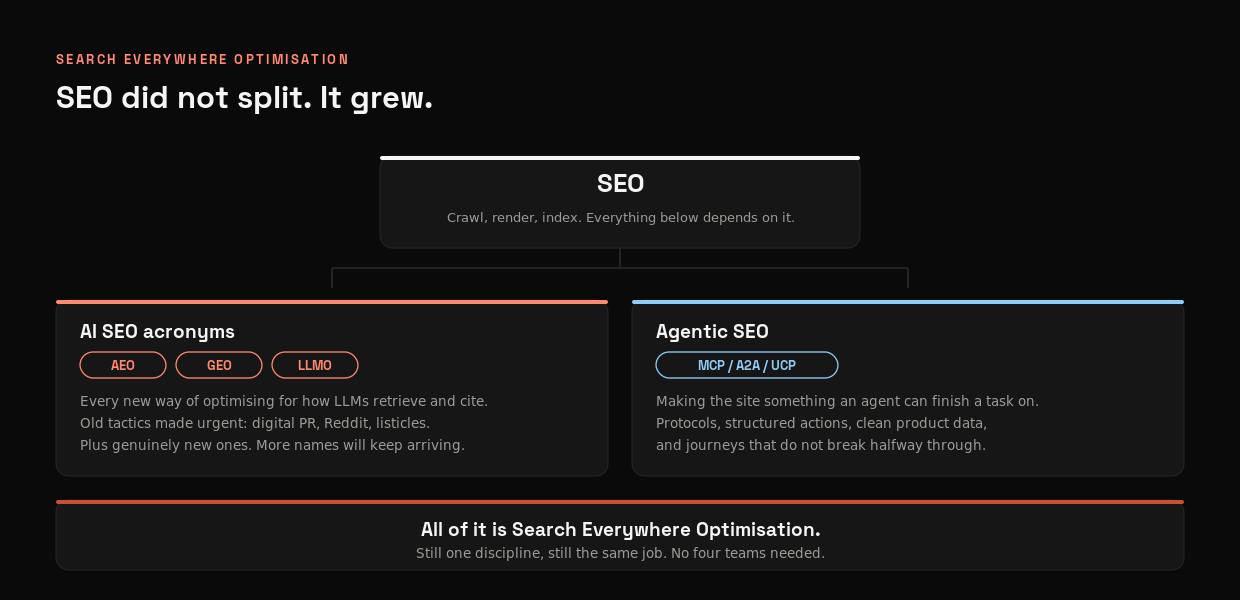
My view is that they all describe mainly the same thing: The tactics that work on LLMs.
Some of those existed long before LLMs did and their effectiveness on LLMs has pushed them up the priority list and they were already there: Digital PR, Reddit and listicles were all sitting in the SEO toolkit years before anyone said GEO out loud. Others are genuinely new, like agentic protocols or llms.txt and had nothing to optimise for until LLMs existed.
Either way I see all of it as a natural evolution of search engine optimisation, now emerging as Search Everywhere Optimisation and all of it very much part of an SEO’s job. No four teams needed.
What has genuinely changed about organic search?
The acronyms are mostly noise, though the shifts underneath them are real. These are the ones that matter:
- A citation behaves differently from a backlink.
- A prompt is an unreliable replacement for a keyword.
- A mention inside an answer creates a different outcome from a ranking that sends thousands of visits.
- Third-party descriptions can influence the answer as much as anything on your own website.
That last piece is the one I’d sit with longest, because it’s the one that takes the work out of your hands. Eli Schwartz reaches a similar place from a different direction, arguing that AI visibility sits closer to brand marketing than to SEO, because established and frequently referenced entities have a structural advantage. I think he is right about the mechanism and I’d push back on the framing. Brand strength helps enormously and I talk about it more here, but it doesn’t help at all if the crawler gets a 403.
Brand gets you considered. Access gets you retrieved. All fronts need covering.
Prominence still exists without a ranking page. Being presented first, included among several options, or left out entirely produces very different commercial results, even though none of those positions carries a number. What AI search expanded is the list of outcomes worth measuring and the number of teams who can move them.
How LLMs Actually Find Things: Training, Retrieval and RAG
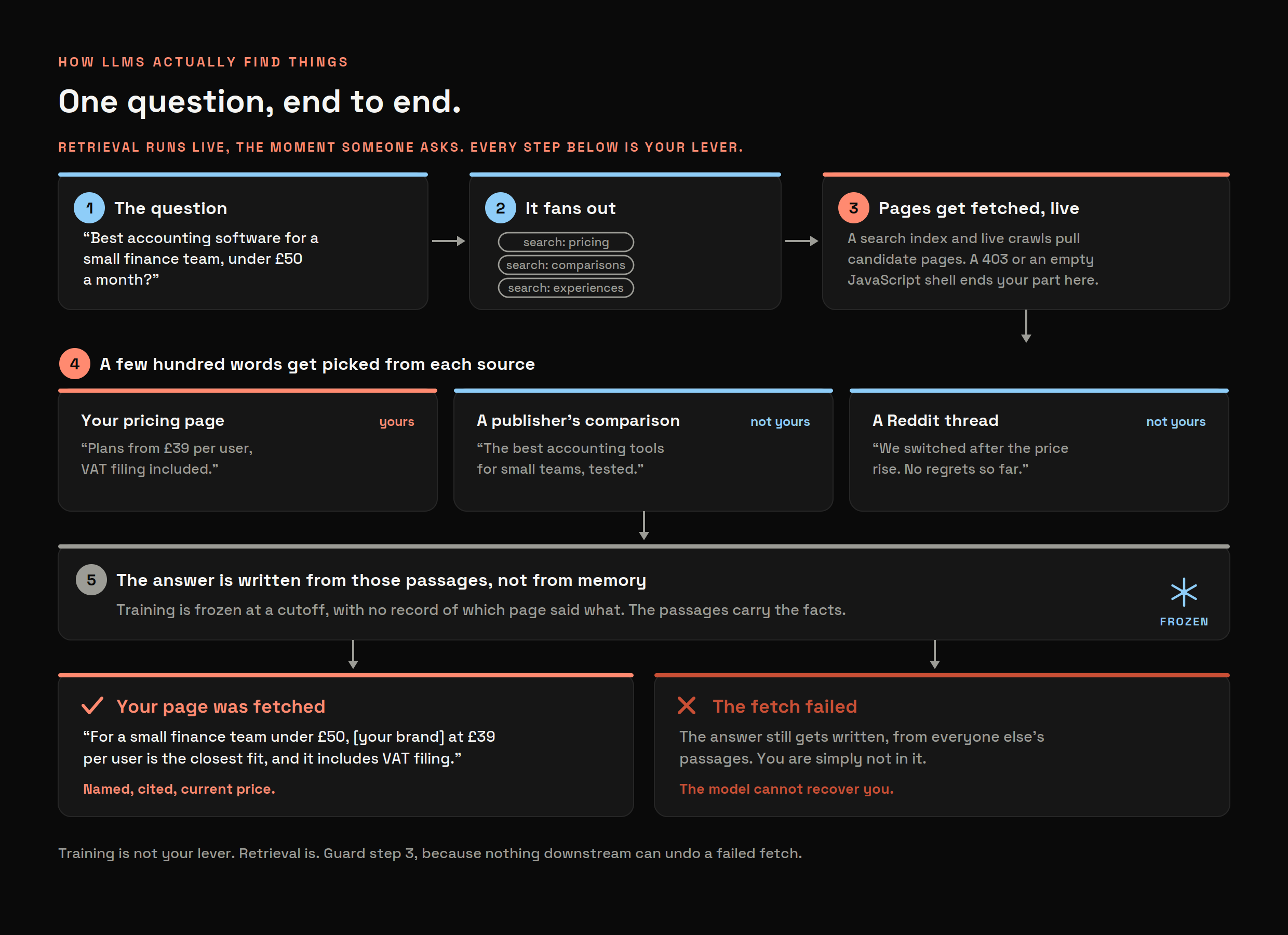
People assume the model already knows their brand and is deciding whether to mention it. Usually it’s doing something much more mundane: Running a search and reading whatever comes back.
These two things feed an answer and they work on completely different timescales:
- Training is what the model absorbed when it was built. Frozen at a cutoff date, with no record of which page said what and you can’t edit any of it. If your brand appears often enough across the open web, some impression of it lives in there, though it will be months out of date.
- Retrieval happens the moment someone asks. The system searches, fetches live pages and reads them before writing a word. Almost all of your commercial visibility travels through this route and you can influence it this week.
The RAG pipeline in 4 steps
Retrieval-Augmented Generation (RAG) is the plumbing. The name describes the sequence: Retrieve first, then generate. Britney Muller puts it well: A training-only model sits a closed-book exam, a RAG model gets to look things up first.
- The question expands: One prompt becomes several related searches. That’s query fan-out, which we will come back to.
- Candidate sources get fetched from a search index, a live crawl, or a vector store where content sits chopped into passages and stored as embeddings, which are numerical representations of meaning.
- The most relevant passages get selected and handed to the model as context. Usually a few hundred words of your page.
- The answer gets written from those passages, with citations depending on the product.
These consequences follow and between them they explain most of what this article recommends:
- Your page arrives as a fragment: Whatever gets grabbed has to make sense on its own, without a heading 3 scrolls up to explain it, which is the real reason to write in clear, self-contained chunks. Anyone selling that as a hidden ranking factor is overreaching.
- Freshness is a live signal: A price that changed last week is wrong in today’s answer if the page still says otherwise.
- Step 2 is a hard gate: A 403, an empty JavaScript shell or a blocked crawler stops everything, because the model can’t fall back on what it “knows” about you and no amount of brand strength rescues a failed fetch.
Which is why the next section spends its time on crawling, rendering and feeds.
How AI Search Engines Differ: ChatGPT, Perplexity, Gemini and AI Overviews
People talk about “ranking in LLMs” as though every product shares one index, one retrieval process and one set of citation rules. They don’t. The systems are largely opaque, they change often, and behaviour varies by model, mode, query and location.
Each product runs its own source-selection process. “Ranking factors” is a convenient way to describe it, borrowed from how we talk about SEO, even though there was never a list there beyond best practices. Retrieval, relevance, freshness, fan-out and user context all feed into who gets cited.
| Platform | What people use it for | How it retrieves | What earns a citation there |
|---|---|---|---|
| Google AI Overviews | Quick answers inside an ordinary search, now on roughly half of US queries. | Query fan-out across sub-queries, then it cites pages that keep appearing across those sub-query results. Pages must be indexed and snippet-eligible. | Only 38% of cited pages rank in the top 10. YouTube is now the most cited domain, then Reddit, Quora and LinkedIn. Video and community content punch above their weight. |
| Google AI Mode | Longer, multi-part questions and follow-ups. Past a billion monthly users inside a year. | Its own fan-out, run independently of AI Overviews. Answers come back roughly 4 times longer. | Encyclopedic depth. Wikipedia appears in 28.9% of AI Mode citations against 18.1% in AI Overviews and Quora 3.5x more. Only 13.7% of its citations overlap with AI Overviews. |
| ChatGPT | General research, writing and comparison, at 900m weekly users. The default for most people. | Searches the live web mid-conversation through OAI-SearchBot. It leans low: Semrush found the pages it cites rank 21+ almost 90% of the time. | Encyclopedic authority. Wikipedia alone is 7.8% of all its citations and nearly half its top-10 share, then Forbes, G2 and TechRadar. |
| Claude | Long research, coding and document work. Skews technical and B2B and Anthropic now takes 40% of enterprise AI spend. | Iterative searches, refining the query mid-answer and citing what it read. Anthropic has never named its index, though it added Brave Search to its subprocessor list and Simon Willison found a BraveSearchParams parameter in the API. Its fetch tool doesn’t render JavaScript at all. | Ranking in Brave, in practice. Profound compared Claude’s citations against Brave’s top non-sponsored results and found 86.7% overlap on a small 15-result sample, against 26.7% for ChatGPT and Bing. On top of that: Primary evidence, stated methodology and server-rendered HTML, because a JavaScript shell that Googlebot can still read is invisible here. |
| Perplexity | Web research where the sources matter as much as the answer. | Web-first. PerplexityBot fetches on nearly every prompt and citations sit inline. | Community above everything. Reddit is 46.7% of its top-10 citation share, then YouTube, Gartner, Yelp and G2. It is also the most SEO-aligned of the assistants: Ahrefs found nearly 1 in 3 of its citations rank in Google’s top 10, against 12% for the rest. |
| Gemini | Quick tasks inside Google’s own products, at 900m monthly users on the app. | Google’s index, plus your Workspace files if you connect them. Sources sit behind a Sources button and it links out when it quotes at length. | Reddit, YouTube and Wikipedia lead. Its source mix looks more like Perplexity than like AI Overviews, despite the shared parent company. |
| Microsoft Copilot | Work questions inside Microsoft 365, plus Copilot Search in Bing. | Bing’s index. Inside Microsoft 365 it can blend web grounding with authorised work data. | Bing indexing is the gate and Bing is a separate crawl from Google’s. Missing from Bing means missing here entirely. |
Treat those as tendencies, because they will move.
My LLM stack, for what it’s worth. Claude is my go-to for anything complex: Building, coding and research, somewhere between Pro and Max depending on the month. ChatGPT Pro is my default for everyday search, image generation, email and writing and it picks up the complex work once my Claude usage runs out. I have Google AI Pro and use Gemini inside Google’s ecosystem for quick uncomplicated tasks. I read AI Overviews with a pinch of salt and I don’t use AI Mode because I dislike the experience. I’m not paying for Perplexity or Copilot, though I’d consider Copilot if I lived inside the Microsoft ecosystem. None of that is a recommendation, just a reminder that your customers are making equally arbitrary choices, on equally personal grounds and your visibility has to survive all of them.
The AI Overviews row is the one that changes how you plan. Ranking is no longer a reliable proxy for being cited, according to these datasets:
- Ranking has decoupled from citation: Across 863,000 keywords and 4 million AI Overview URLs in March 2026, Ahrefs found citations from top-10 pages halved in 8 months, from 76% to 38%. Roughly 31% now come from pages outside the top 100 entirely.
- Google’s own two surfaces disagree with each other. Ahrefs found 13.7% citation overlap between AI Mode and AI Overviews, against 86% semantic agreement. Same conclusion, different sources.
- The platforms barely share a source list. Ahrefs analysed the 50 most-mentioned websites in June 2025 across 76.7 million AI Overviews, 957,000 ChatGPT prompts and 953,500 Perplexity prompts. 7 sites appeared on all 3, a shared overlap of 14%. Across 15,000 prompts, a second study found only 12% of URLs cited by ChatGPT, Gemini and Copilot ranked in Google’s top 10 for the same prompt and roughly 10% for Bing’s.
- Each one has a different favourite. Profound’s analysis of 680 million citations found ChatGPT cited Wikipedia most across its 2024-25 dataset, while Reddit led for both AI Overviews and Perplexity.
So measure AI visibility separately from rankings. Just don’t read any of this as permission to stop doing SEO, because a page still has to be crawled, indexed and snippet-eligible before it can be cited anywhere. Whichever domain leads in a given quarter will change, while the gap between platforms won’t.
Which is why I stopped reporting “visibility” as one number. A mention with no citation, a mention where a third party gets cited instead of you, your own page cited and an action link such as a product or buying destination are all different results and a page can win one while losing another.
So I track several numbers side by side:
- Share of voice: Traditional search engine visibility, which still carries most of the traffic and still tells you whether the foundation is holding.
- AI Overview ownership: How often your own pages are the ones cited inside Google’s generated answers.
- Brand citations: Where the brand gets named across assistants and whether the link points at you or at a third party writing about you.
- AI visibility by cluster: Tracked against the topic clusters that matter commercially, or against an industry benchmark.
Keep them as separate columns, because a quarter where citations rise and share of voice falls is a very different quarter from the reverse and a single blended score hides both.
Any model, algorithm or interface update can change one of those without touching the others. From my experience, the same brand can sit comfortably inside Perplexity and Google’s AI surfaces for a topic and be nearly absent from ChatGPT for the same topic. Same site, same content, same week. If you’ve only been reporting a single visibility number, that’s a difficult meeting.
There’s no universal AI ranking system to optimise a page for. What brands need is consistent, accessible, well-supported information sitting across every source environment these products might reach into.
SEO Is the Foundation of AI Search Visibility
According to Google Search Central, supporting pages for AI Overviews and AI Mode must be indexed and eligible to appear in Search with a snippet. There’s no special technical route around that.
The same accessibility principle applies beyond Google, where OpenAI’s publisher guidance identifies OAI-SearchBot as its search crawler and Perplexity’s documentation recommends allowing PerplexityBot so sites can appear in its search results. All of these crawlers need to be allowed in your robots.txt, or at the very least not disallowed. Yes, that same robots.txt, handled by your friendly SEO.
Client-side rendered content is invisible to practically all crawlers
If your content only exists after the browser runs your JavaScript, it doesn’t exist for most of the machines deciding whether to cite you. Googlebot is the only major crawler that fully renders JavaScript, which makes server-side rendering the quickest and most widely accessible route into an index. Bing’s rendering is limited and unreliable enough that it still recommends serving rendered HTML and the AI retrieval bots mostly don’t render at all.
At Google the cost is real, though smaller than people usually claim. Googlebot does render JavaScript, in a queued stage that runs after the initial crawl and Google has said the median wait there is about 5 seconds with a 90th percentile of minutes, so the old “rendering takes weeks” line is out of date. What’s left is resource: Rendering costs Google far more than reading HTML and anything you make expensive to process is something you’re relying on Google to keep choosing to do.
Outside Google it stops being a cost and becomes a wall. Anthropic’s web-fetch documentation says plainly that the tool “doesn’t support websites dynamically rendered with JavaScript” and most retrieval bots behave the same way, fetching raw HTML and reading whatever is in it. If your initial HTML is an empty application shell, they miss the copy, the internal links, the product details and the evidence that all arrive later in the browser.
So server-side rendering solves both halves at once, because it takes Google out of the rendering queue and it removes the blindness entirely for every assistant that never had a renderer to begin with. Put the things you want quoted into server-rendered or statically generated HTML wherever it’s practical to do so.
The clearest example I’ve seen came from a bot log audit I ran on a large consumer web platform.
Over the same 3 weeks, the main domain drew assistant citations in the hundreds of thousands. Its own developer documentation subdomain drew them in double digits. Same brand, same window, a gap of roughly 1,000 to 1.
The documentation was the most detailed and most useful material the company had. It was also a client-side rendered single-page app, so the assistants fetched it, found an empty shell and left. Everything worth quoting arrived after the JavaScript ran and none of them stayed for that.
The technical baseline remains familiar
It comes down to the same things SEOs have always worked on, except more systems depend on them now:
- Crawling: Can a bot reach the page at all? Important URLs return a usable response, robots.txt and any CDN or security rules allow the crawlers you want and budget isn’t being burned on redirects, tracking paths or discontinued products.
- Rendering: Does the content exist in what actually gets fetched? Key facts, internal links and product details belong in the initial HTML. Googlebot renders JavaScript and most retrieval tools don’t.
- Indexing: Can it be stored and retrieved later? Canonical signals resolve cleanly, internal links make the relationships legible, structured data matches what a human sees and product, local-business and other feeds stay current.
None of that is new and that is rather the point. A system can’t cite information it can’t retrieve, so every clever AI-visibility tactic further down this article is sitting on top of whether the crawler got a 200 and found some text.
None of this shows up in a content audit, only in server logs, so pull them.
On that same audit, I stopped asking whether the assistants could reach the site and started asking what they were spending their time on and the answer wasn’t the product pages.
Near the top of the most-crawled list sat a batch of internal tracking and affiliate redirect URLs. There’s nothing on a redirect handler for a model to quote. Just below them was a landing page for a product the company had discontinued years earlier, still being fetched in volume, still being trained on. A dynamic search-results page had pulled 6 figures of assistant fetches against a few hundred indexing visits, which is exactly what it looks like when a bot keeps coming back and never finds anything stable enough to keep.
Then the quiet one. A pricing page and its own page-2 duplicate were both being crawled hard, with more than a third of the combined signal sitting on a URL that should never have existed separately.
Nobody built any of that deliberately. It accumulated over years of ordinary site changes and none of it was visible until someone opened the logs.
Google’s View on AI Search, AEO and GEO
Google’s AI optimisation guide is the clearest thing its search team has published. If you read one primary source this year, read that.
AEO and GEO are still SEO for Google
Google describes AEO and GEO as names for optimisation in generative-AI experiences and its conclusion is blunt: “AEO/GEO is still SEO.” That covers Google’s products and nothing else, as the platform comparison above shows.
There’s no special AI technical checklist
Google says pages don’t need special AI markup or a separate machine-readable version, because the existing Search requirements and policies still apply. Accurate structured data remains useful for the purposes it always served, but there’s no dedicated AI schema and no citation switch, whatever anyone is selling.
The llms.txt question, answered shortly
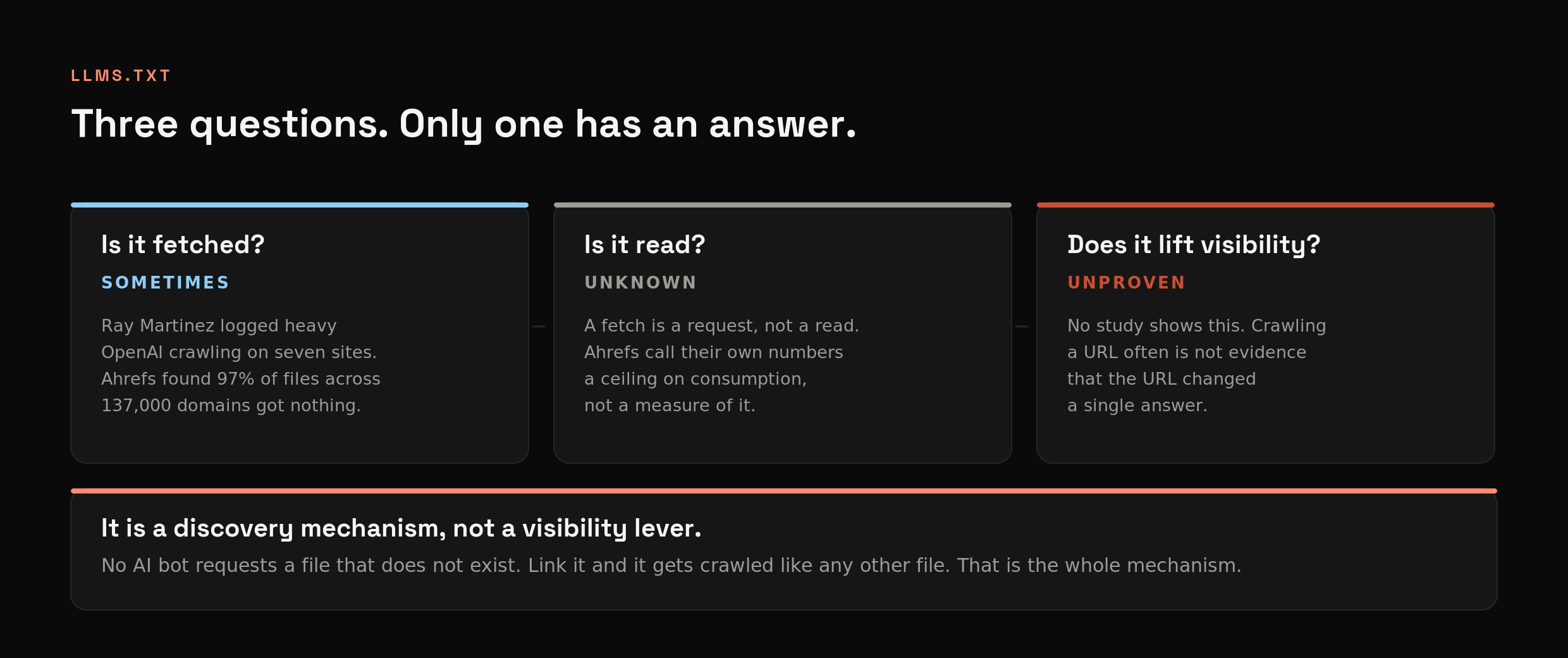
Google ignores llms.txt. It added a dedicated clarification to the guide in late May 2026: Keeping the file is fine and it neither helps nor harms visibility in Google Search. Days later the Chrome team shipped an llms.txt check inside Lighthouse’s agentic browsing audits, so Google argued both sides within a week. John Mueller called it “not done for search” and a temporary crutch for AI coding tools.
The argument gets messy because separate questions keep getting collapsed into one. Pull them apart and the evidence lines up cleanly:
- Is it fetched? Sometimes and rarely. Ahrefs tested 137,000 domains and found 97% of published files received no requests whatsoever in a month. AI retrieval bots accounted for 1.1% of the traffic that did arrive. No AI bot ever requested a file that didn’t exist, so nothing goes looking. My own logs matched: Nothing fetched mine until I linked to it, after which it got crawled like any other file. And the ones that do get published are often unusable anyway. On that same audit I found one running to hundreds of kilobytes, far past the point where a model stops reading and drawing almost no crawl traffic. A file nothing fetches, that nothing could finish reading if it did.
- Is it read? Nobody knows: The counter-evidence people reach for is Ray Martinez’s research, which found OpenAI’s search bot hammering the file across 7 sites. That’s real and it answers question one while leaving question two open. Ahrefs are explicit that a fetch isn’t a read and call their own figures a ceiling, which is a more honest word than measure. Worth noting Ray’s study was published by a platform that generates these files for its customers.
- Does it lift visibility? Nobody has shown it. Mark Williams-Cook settled this by inventing
cats.txt, a file about office cats and their purring frequency and running it against the 4 proofs people offer for llms.txt. It passed all 4, which tells you what those proofs were worth.
So it works as a discovery mechanism and has never been shown to work as a visibility lever.
If you keep one, link it, keep it small and treat it like code, because that is what it behaves like. Agents are built to trust it, which turns a stale file into a security problem and that is a very different order of risk.
Chunking isn’t a Google AI requirement
Google says publishers don’t need to split pages into tiny chunks. Its systems can find a relevant passage inside a page covering several topics, there’s no ideal word count and it advises writing for your audience.
Structure still earns its place, because descriptive headings, direct explanations and logical sections help readers scan a page and Similarweb recommends exactly those practices in its content-chunking guidance. Treat them as good editorial habits. Anyone presenting them as a hidden Google ranking factor is overreaching and I’d push back on that.
Google wants distinctive information
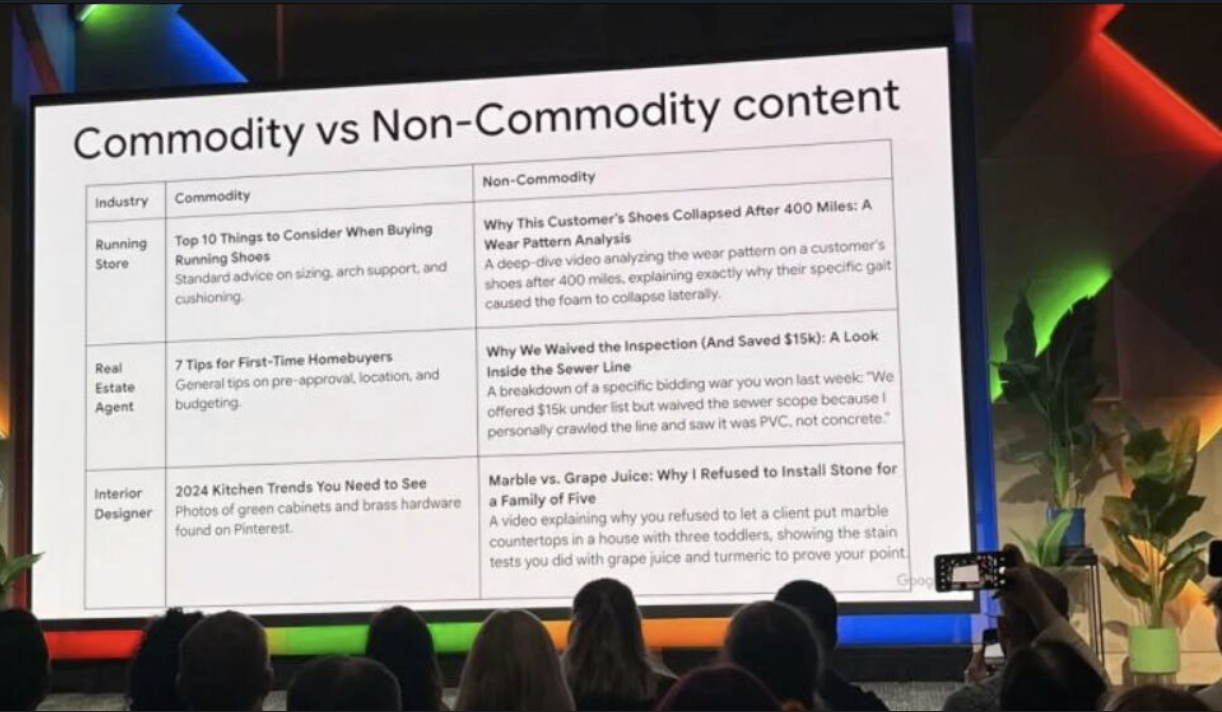
Google recommends “non-commodity” content: First-hand experience, original viewpoints, anything beyond a summary of pages that already exist. It discourages building a separate page per fan-out query and it lines up with its people-first guidance. Ask of any page whether it contributes evidence, experience or clarity worth retrieving.
Google sees feeds and business data as part of AI visibility
Google’s AI optimisation guide points ecommerce and local brands towards Merchant Center feeds and Google Business Profiles. Accurate prices, availability, policies, locations and product details give its systems current structured facts to work with.
This is the part most SEO teams underrate, in my experience, because feed accuracy usually belongs to someone else in the business.
Google’s message across the whole guide is consistent: Do the SEO properly, keep the facts accessible and keep the feeds accurate, because there’s no second door.
Search Everywhere Optimisation: Building Consistent Brand Visibility
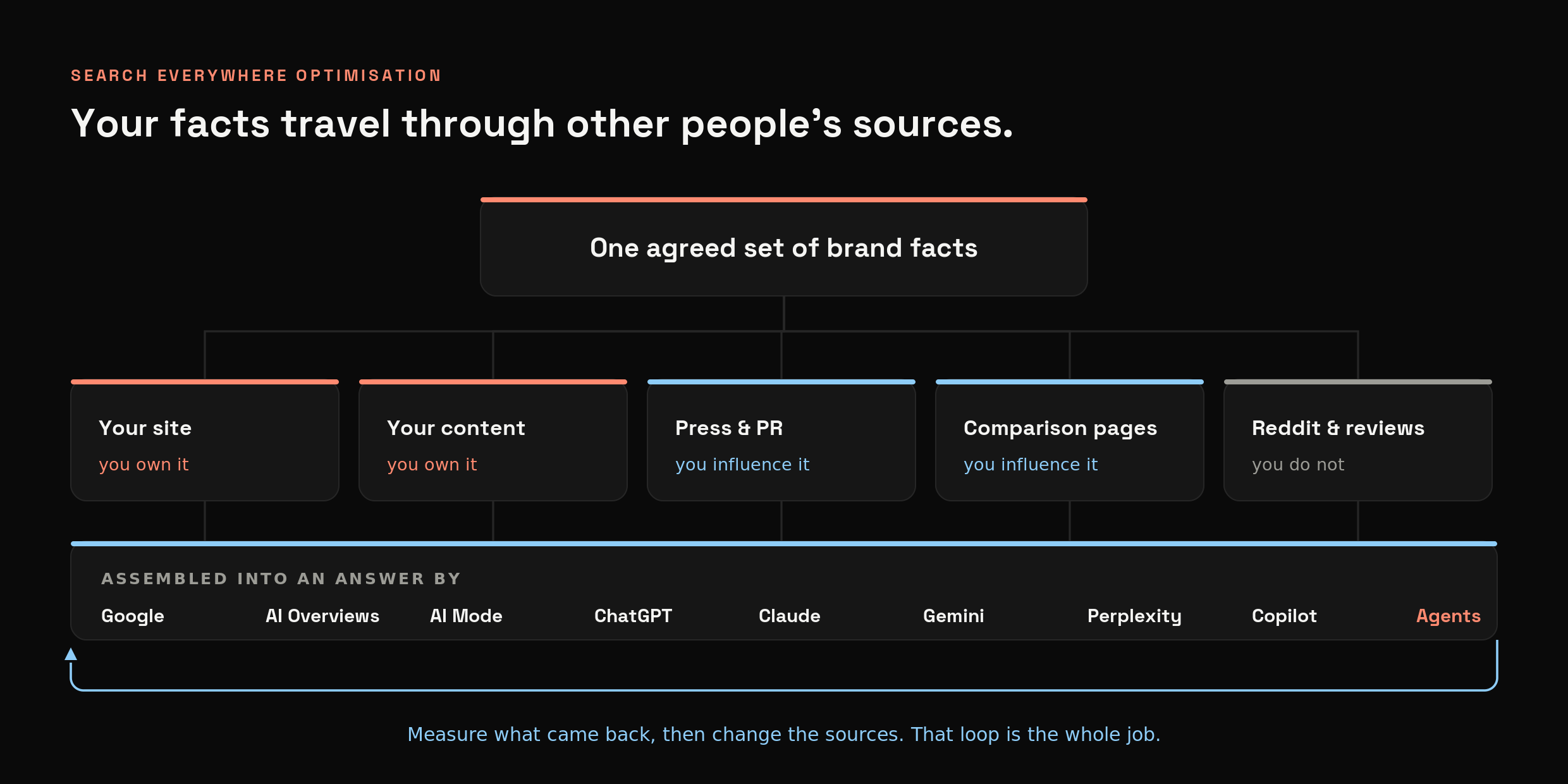
AI systems assemble answers from brand sites, publishers, comparison pages, reviews, forums and product data. In a March 2026 study of 30 million cited sources across 5 platforms, Peec AI put Reddit, YouTube and LinkedIn at the top overall.
Search Everywhere Optimisation is my preferred name for the wider remit because it starts from the right question: Where do customers search, compare and decide and what would make you useful there?
The objective is one recognisable, defensible account of a brand across many sources. Identical marketing copy everywhere is neither realistic nor useful. Hold the core facts steady and let the register change to suit whoever is reading.
Brand and messaging establish the shared context
Websites, About pages, product pages, profiles, feeds and spokesperson comments should agree on:
- Who the brand serves.
- What its products or services do.
- Which category it belongs to.
- Why it’s relevant or different.
- Which claims can be supported with evidence.
- Which facts, prices and policies are current.
Brand teams define the clearest defensible messages, SEO and content teams make them discoverable and product and data owners keep the facts current. When those 3 groups disagree, AI systems will find the disagreement and repeat it back to your customers.
Affiliates, publishers and collaborators shape shortlists
Commercial questions draw heavily on listicles, comparisons, reviews and specialist publications. Peec AI’s Listicle Rank Effect study analysed almost 200,000 AI responses and found a relationship between a brand’s position in cited listicles and its visibility in generated answers. The strength varied by industry and engine.
SEOs and marketers can:
- Identify publishers and affiliate pages cited for valuable buying questions.
- Check whether the brand is included and accurately described.
- Find outdated claims, missing differentiators and weak category positioning.
- Offer useful product access, expert input, original data or transparent partnerships.
- Measure whether changes affect inclusion, prominence and sentiment.
A handful of influential comparison pages in a specialist category beats hundreds of unrelated placements. I’d rather lose a placement than pay for one that gets a publisher delisted.
Reddit and communities provide experience and opinion
Reddit shows up constantly because real questions need lived experience and a spec sheet cannot supply it. People want drawbacks, alternatives, reliability and what actually happened 6 months after purchase. Peec AI found Reddit was the most-cited domain overall in its study, ranking first or second on every platform tested. That’s a broad benchmark, so your prompts and your industry will look different.
Lily Ray has documented ChatGPT retrieval examples using site:reddit.com or specific subreddits for opinions and product experiences. She also observed brand-site searches for specifications and government-domain searches for sensitive subjects.
So listen, answer genuine questions where participation is welcome and route recurring feedback into product and support. Manufactured praise costs you the trust you were trying to build.
Query fan-out connects the source environment
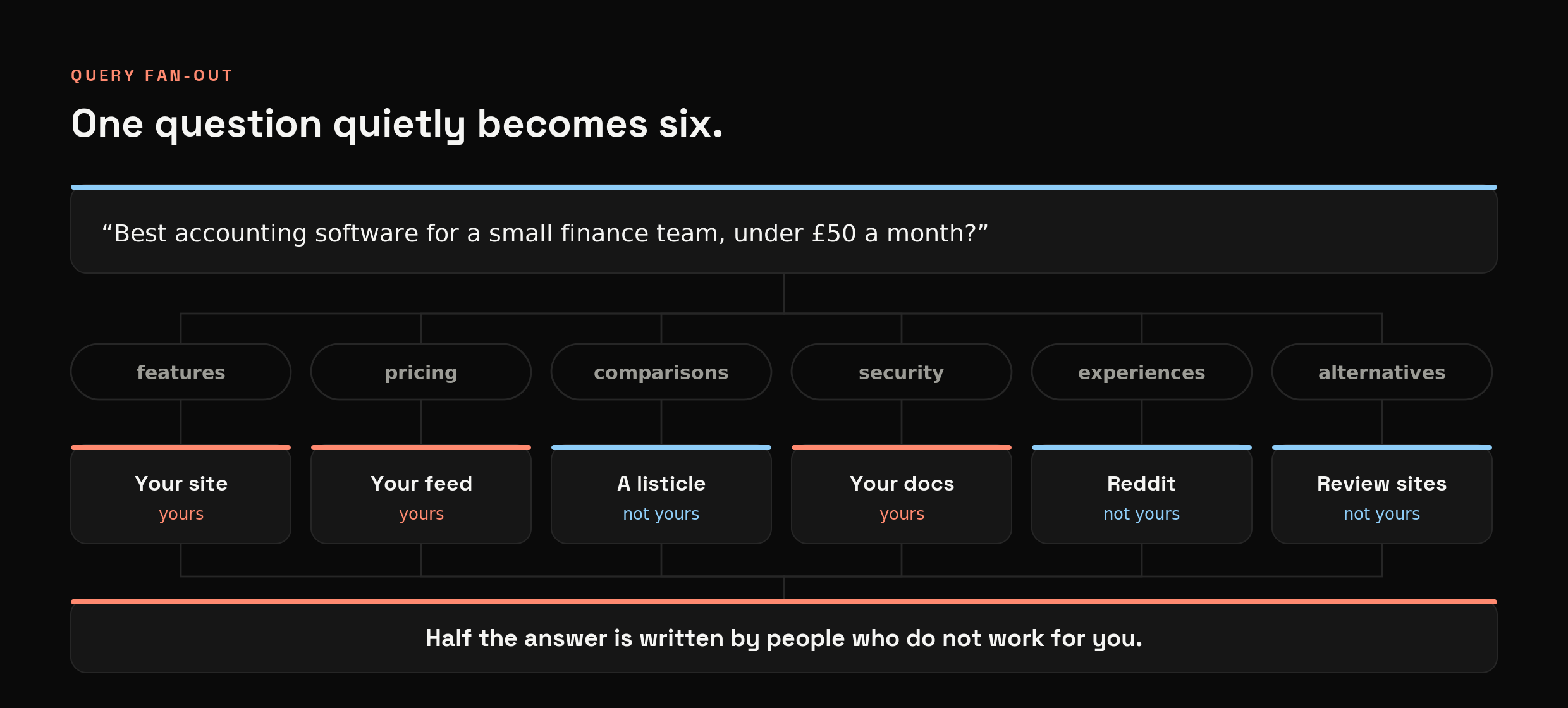
Query fan-out means one question can trigger several related searches behind the scenes. Ask for the best software for a small finance team and the system may run searches covering features, security, pricing, comparisons, customer experiences and alternatives before it writes a word.
The resulting answer might use:
- The brand site for product specifications.
- A publisher’s comparison for the shortlist.
- Reddit for customer experiences.
- Reviews for recurring strengths and weaknesses.
- Digital PR coverage for evidence and authority.
- Product feeds for current prices or availability.
Consistency raises the odds that different systems reach the same conclusion wherever they look. Contradictions do the opposite and they are far more common than brands realise until someone audits it. 9 or 10 teams influence what AI systems find and most of them have never been in a search meeting, which is why running this as an SEO project is how it stalls.
AI Search Strategy: Prompt Sets, Baselines and Experiments to Run
There’s no universal formula for AI visibility, because results shift by query, platform, model, country, industry and time of asking, so treat everything below as a hypothesis you should test.
1. Build a useful prompt and query set
Start with personas grounded in evidence: CRM data, customer interviews, sales calls, support tickets, site search, keyword research. I’ve sat through the invented-demographic workshop and what comes out of it is a deck that changes none of the questions.
For each priority persona, record the problem, the constraints, the language they use and the sources they already trust. Then build a persona-by-journey matrix, because one mixed list will always under-serve somebody:
| Persona | Journey stage | Example prompt pattern |
|---|---|---|
| First-time buyer | Problem discovery | “What should I consider when choosing [category] for [need]?” |
| Technical evaluator | Comparison | “Compare [options] for [technical requirements], including limitations and integration effort.” |
| Budget owner | Validation | “Which [category] options suit [company size] under [budget] and what evidence supports the recommendation?” |
| Existing customer | Post-purchase | “How do I complete [task] in [product] and when should I contact support?” |
Cover the full arc for every commercially important persona, from problem discovery through comparison and objections to post-purchase. Write in their language, add follow-ups because these are conversations and keep a stable core set so the trend line means something.
2. Establish an AI-search baseline
For each query or prompt, record:
- Whether an AI answer appears.
- Which brands are included and in what order.
- How each brand is described.
- Which pages and domains are cited.
- Whether the cited source is owned, earned, community-led or commercial.
- Whether the output contains incorrect or outdated information.
AccuRanker can track AI Overview visibility and citations, Ahrefs Brand Radar can identify cited domains, pages and fan-out queries and platforms such as Peec AI monitor brand mentions, sentiment, sources and competitors across several engines. Whichever you pick, run the same prompt set every time or the trend line is worthless.
3. Diagnose the source gap before choosing a tactic
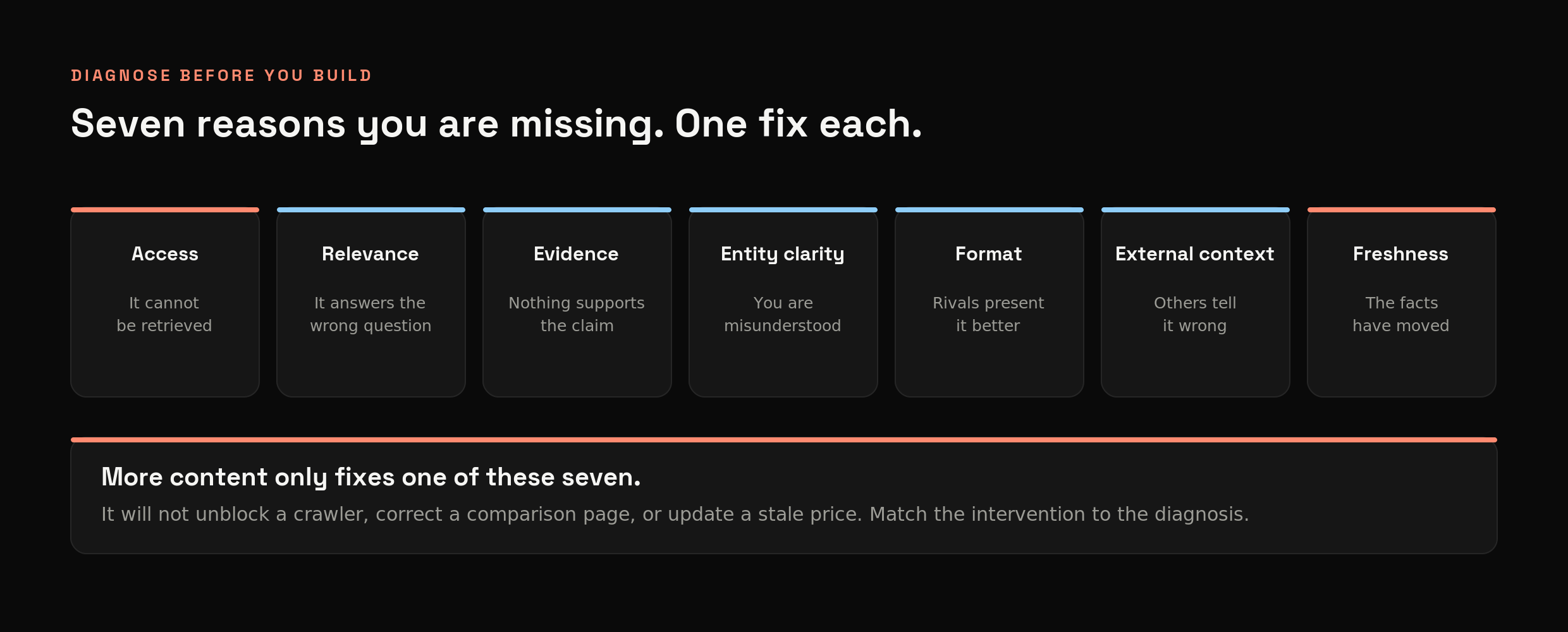
This is the step teams skip and skipping it is why so much AI search work produces nothing. “We aren’t showing up” only describes the symptom. It has at least 7 distinct causes and the fix depends entirely on which one you have. I use these 7 because each one has a different fix and a different owner:
- Access: The useful page or fact can’t be retrieved.
- Relevance: The available content doesn’t answer the real question.
- Evidence: Claims lack original data, experience or support.
- Entity clarity: The system misunderstands the brand, product or category.
- Format: Competing sources present the information more usefully.
- External context: Publishers, affiliates, reviews or communities tell an incomplete story.
- Freshness: Prices, product details or claims are outdated.
Match the intervention to the diagnosis, because in my experience the two that actually bite are access and external context and neither of them sits with the content team.
Only 1 of those 7 is fixed by publishing more content. Publishing more content is what gets commissioned almost every time.
4. Test distinctive content and clear structure
The experiments worth running all add something a summary can’t: Original data with a transparent methodology, first-hand product or customer experience, balanced comparisons with stated selection criteria and honest limitations. Concise answers inside a logically structured page help too.
The original GEO research found that citations, quotations and statistics could improve source visibility in its experimental setting, with results varying by query and domain. That supports testing, though it doesn’t establish a rule for every page.
Chunking belongs in this experimental category too. Test clearer headings and self-contained explanations for usability and retrieval, by all means. Just stop short of presenting fixed paragraph lengths or tiny answer blocks as confirmed Google requirements, because Google has said the opposite.
5. Retest and look for patterns
Generated outputs move. Ahrefs found considerable volatility when it followed 43,000 AI Overview keywords for a month.
Profound calls this “citation drift”. In a study of around 80,000 prompts per platform, 40.5% to 59.3% of cited domains changed between June and July 2025 across Perplexity, Copilot, ChatGPT and Google AI Overviews. Comparing January with July 2025, the drift reached 70% to 90%.
This goes well beyond algorithm updates under a new name. Models are probabilistic, retrieval systems change, new model versions ship and interfaces quietly alter whether they show a mention, a citation, an owned link or an action link.
So repeat tests across dates, platforms and model changes and record mentions, cited domains, owned links and prominence as separate things. Compare manual checks with tools such as Profound’s Answer Engine Insights. A single screenshot is an anecdote. Run it 20 times and you have evidence.
How to Measure AI Search Traffic and Visibility
AI referral benchmarks describe the traffic your analytics can attribute to an AI source. They don’t capture every AI-influenced visit and the gap between those two things is where most reporting arguments start.
The number everyone quotes is around 1%. It’s real, it’s small and almost everything people conclude from it is wrong: Here is what the benchmarks actually show:
- The 1% comes from a serious sample. Conductor’s 2026 benchmark put measurable AI referrals at 1.08% of total website traffic across 13,770 enterprise domains, 10 industries and 3.3 billion sessions. That matters, because the figure gets quoted constantly by people who never checked whether it came from a dozen sites or thirteen thousand. Ahrefs’ rolling panel of 107,300 sites lands lower still, with AI assistants at roughly 0.3% of referral traffic against about 28% from search. That dashboard updates monthly, so check it there and please do not just quote me.
- Your industry isn’t the average: Information Technology reached 2.80% and Consumer Staples 1.91%, while Communication Services sat at 0.25%. An 11-fold spread between sectors makes the blended number close to useless for planning.
- It’s still climbing: Conductor measured it growing around 1% month on month across those industries between May and September 2025. Small and growing is a different story from small and static and the two get reported identically.
- One platform carries almost all of it: ChatGPT accounts for around 87%, so “track every platform equally” is a reporting preference with very little traffic behind it.
All of them describe identifiable referrals only. Read them as a lower bound on influence and probably an undercount of clicks too.
Are all AI referrals tracked properly?
No. There’s no shared attribution standard across platforms, surfaces and apps. A mid-2026 review by SearchPilot found the same platform landing in Referral, Organic Search, Unassigned or Direct depending on the device and interface.
| Platform or surface | What analytics can currently see | Main limitation |
|---|---|---|
| ChatGPT | OpenAI adds utm_source=chatgpt.com to referral URLs. Web clicks may also pass chatgpt.com as the referrer. | The UTM has no utm_medium, which can place visits in GA4’s Unassigned channel. Mobile and desktop app hand-offs can appear as Direct. |
| Claude | Web clicks may pass claude.ai as a referrer. | SearchPilot found the web referrer intermittent and app clicks likely to lose it. Anthropic doesn’t add a standard referral UTM. |
| Gemini | Browser clicks can appear as gemini.google.com / referral. | App clicks can lose the referrer or blend into Google Organic. SearchPilot found mobile attribution particularly weak. |
| Google AI Overviews | Clicks appear as Google Organic. | Standard analytics can’t separate an AI Overview click from another Google result. Use Google’s own Search reporting where available and treat site analytics as blended. |
| Google AI Mode | Some clicks can appear as Google Organic. | SearchPilot found many clicks arrived as Direct because the referrer was stripped. |
| Perplexity | Web clicks usually pass perplexity.ai / referral. | App attribution is better than most peers in SearchPilot’s review, although some visits still become Direct. |
| Microsoft Copilot | Some surfaces pass a Copilot referrer or campaign parameter. | Behaviour varies across consumer, search and Microsoft 365 experiences. Validate the exact surface rather than relying on one rule. |
Copying a URL out of an answer, opening a link inside an app, or returning a week later through branded search will each strip the original AI source. Consent settings and analytics configuration take another bite.
Which is why the 1% figure needs describing precisely: It’s measurable AI referral traffic and it doesn’t prove that total AI-driven or AI-influenced traffic is only 1%.
There’s no defensible universal multiplier for the missing share. Anyone offering you one has made it up.
Use several measurement layers
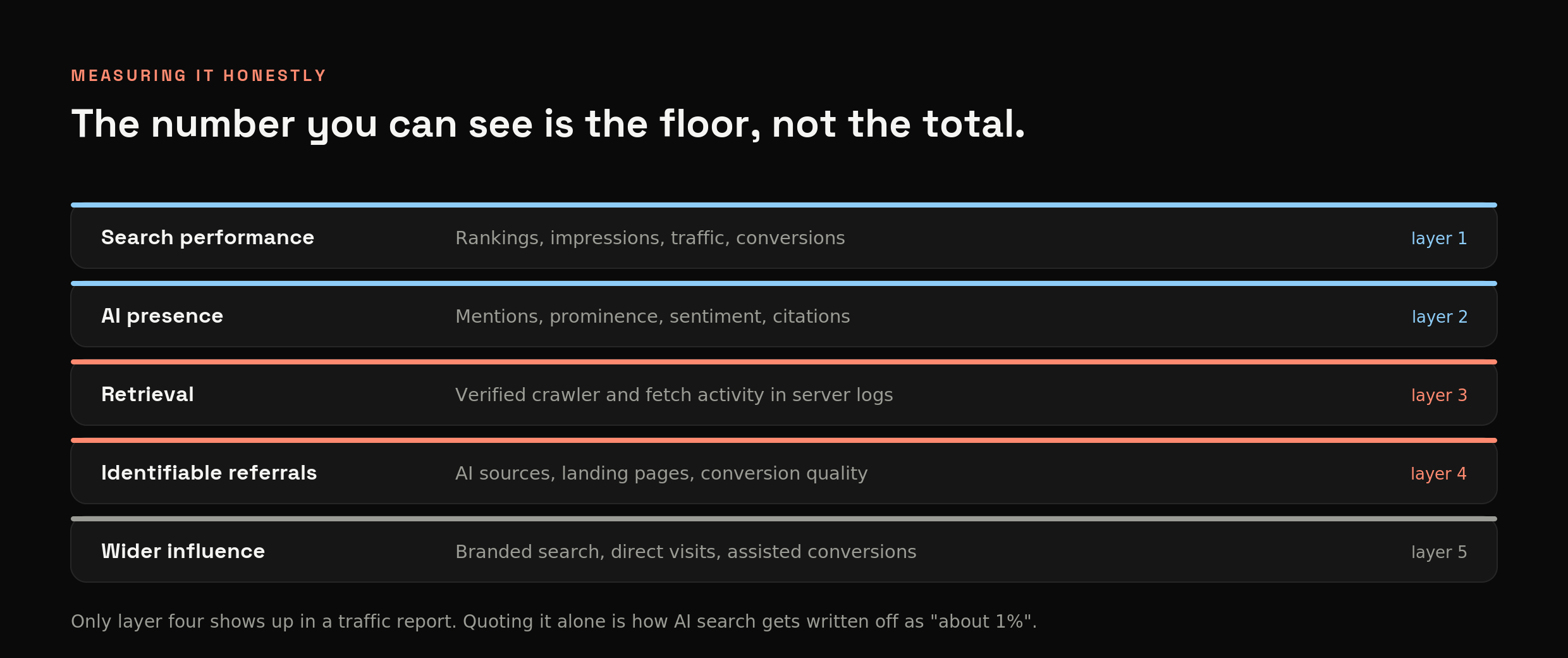
Aleyda Solis describes measured AI referrals as the floor of AI’s contribution. A practical report should combine:
- Search performance: Rankings, impressions, traffic and conversions.
- AI presence: Mentions, prominence, sentiment, citations and owned links across a stable prompt set.
- Retrieval: Verified crawler and on-demand fetch activity from server logs.
- Identifiable referrals: AI sources, landing pages, engagement and conversion quality.
- Wider influence: Branded search, direct visits, assisted conversions and customer feedback.
Profound’s Agent Analytics combines server-side bot tracking with human-referral reporting, which helps close the gaps JavaScript analytics leaves open. Crawler visits are machine activity, though and must never be reported as human traffic.
Layer 3 is where I’d push hardest, because “AI bot traffic” reported as one number is close to meaningless.
Go back to that log audit. 19 AI providers were crawling the site and they weren’t doing the same job. One was sending millions of real-time fetches, the kind that happen while a person sits waiting for an answer. Another sent barely any of those, but well over a million indexing visits, because its assistant reads from an index instead of going to your site when asked. A third sent over a million training visits and not one indexing visit, which is data harvesting and nothing else.
Those are 3 completely different activities and most reports add them into a single “AI bots” line. A rise in training crawls means your content is being absorbed for a model that ships next year. A rise in real-time fetches means customers are asking about you today. Those aren’t the same news and telling them apart is the difference between a log file and a report.
Similarweb reported generative-AI referrals converting at around 7% on transactional sites. Its analysis of the top 1,000 websites separately recorded more than 1.1 billion AI referral visits in June 2025, up 357% on June 2024. Growth and conversion are two different claims and they get merged constantly. Volume, influence and value each need their own measure.
State the caveats in every report: Prompts are sampled, citations fluctuate, attribution is incomplete. A directional view you can defend beats a precise-looking number that falls apart under questioning.
Enter Agentic SEO: From Answering Questions to Completing Tasks
AI products are moving from answering questions to completing tasks. OpenAI’s ChatGPT agent can research and act using tools and a browser.
Google is building for the same thing. Its AI optimisation guide introduces browser agents that can inspect rendered pages, the DOM and accessibility trees, which moves the conversation past whether a machine can read your page and towards whether it can finish a job on it.
A customer might ask an agent to compare products, build a basket, make a booking or configure software, which makes visibility only the start. Your site, your data and your processes all have to support the action that follows.
Where agent protocols fit
Before you start with a protocol, ask an agent to complete one real, commercially valuable task on your site and watch where it fails. Most failures turn out to be ordinary website failures - inaccessible content, inconsistent data, unclear forms - and fixing those comes first, because no standard can rescue a journey that doesn’t work. If the task still fails afterwards because there’s no reliable way to discover knowledge, call a tool or complete an action, then pick the relevant standard and rerun the same test.
They also differ enormously in maturity:
- In practice: A folder of Markdown concept files served from your site, one per idea, cross-referenced.
- What it solves: A format for representing reusable knowledge and context.
- When to consider it: Monitor or pilot it when important knowledge needs to move between people and agents.
Agent Resource Discovery (ARD)
- In practice: A single JSON catalogue at a well-known path listing what agents can use.
- What it solves: Discovery of agent-facing resources and capabilities.
- When to consider it: Pilot it when agents can’t find resources you deliberately expose.
- In practice: A server you run that exposes named tools an authorised agent can call.
- What it solves: Connecting AI applications with tools and data.
- When to consider it: Consider it when an authorised agent needs reliable access to a product, dataset or action that lives outside the public webpage.
- In practice: JavaScript on your own pages declaring what a browser agent can do there.
- What it solves: Exposing structured website tools to browser agents.
- When to consider it: Experiment when a browser task fails through clicks and form interpretation. Chrome describes it as a proposed standard in an origin trial.
- In practice: An agent card plus an endpoint, so another agent can negotiate with yours.
- What it solves: Communication between separate agents.
- When to consider it: Monitor or pilot it when a customer agent needs to coordinate with a brand or partner agent.
Universal Commerce Protocol (UCP)
- In practice: A structured product and checkout feed Google approves before it goes live.
- What it solves: Product discovery and checkout across AI surfaces.
- When to consider it: Consider it for eligible commerce journeys. Google describes UCP as evolving and requires approval before it goes live on its AI surfaces.
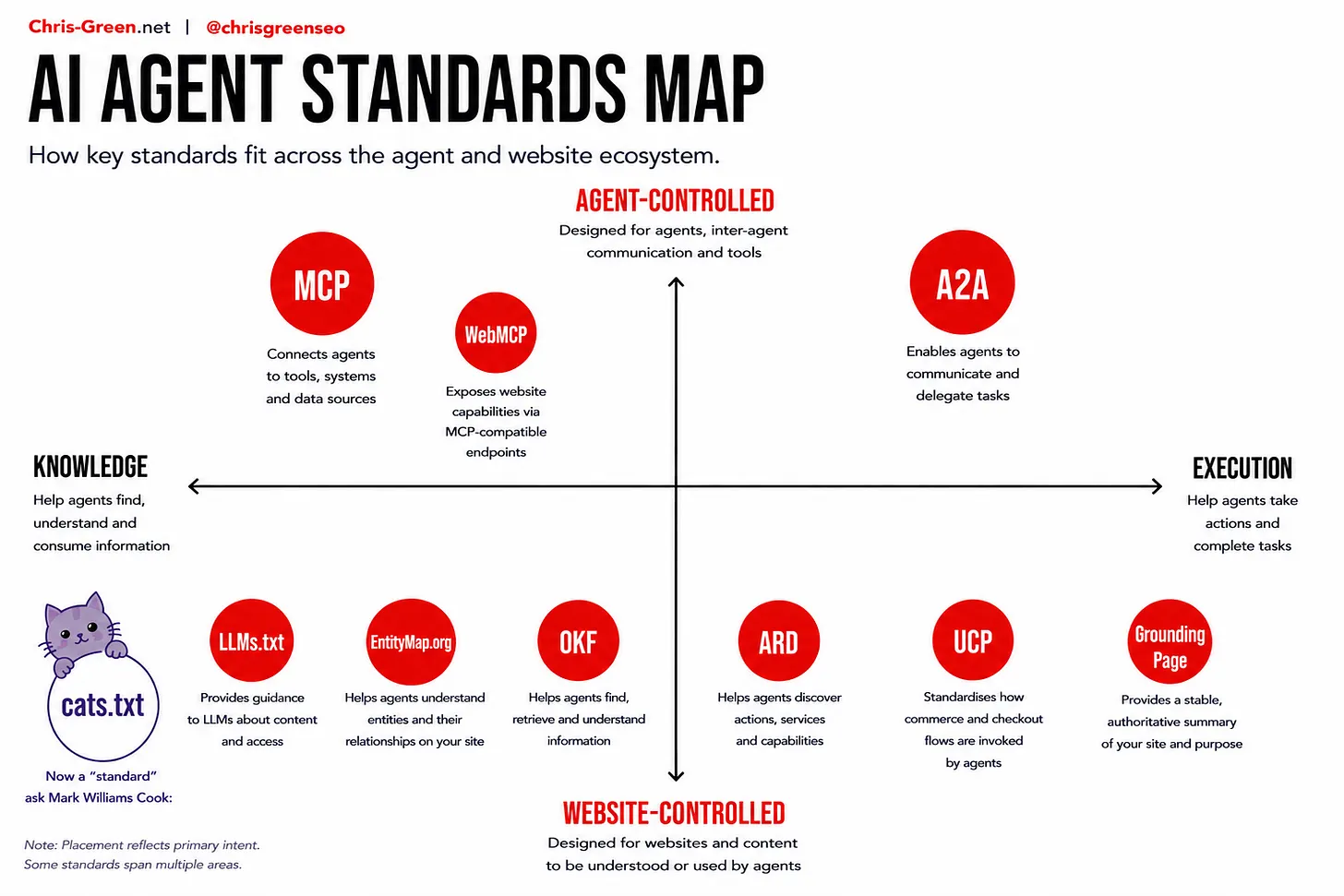
In AI Agent Standards: What Do We Need to Know?, Chris Green maps these across knowledge and execution and website-controlled versus agent-controlled. His advice, which I’d follow: Understand the landscape, improve discoverability, expose capabilities where it makes sense and watch adoption.
How to test, implement and retest agent readiness
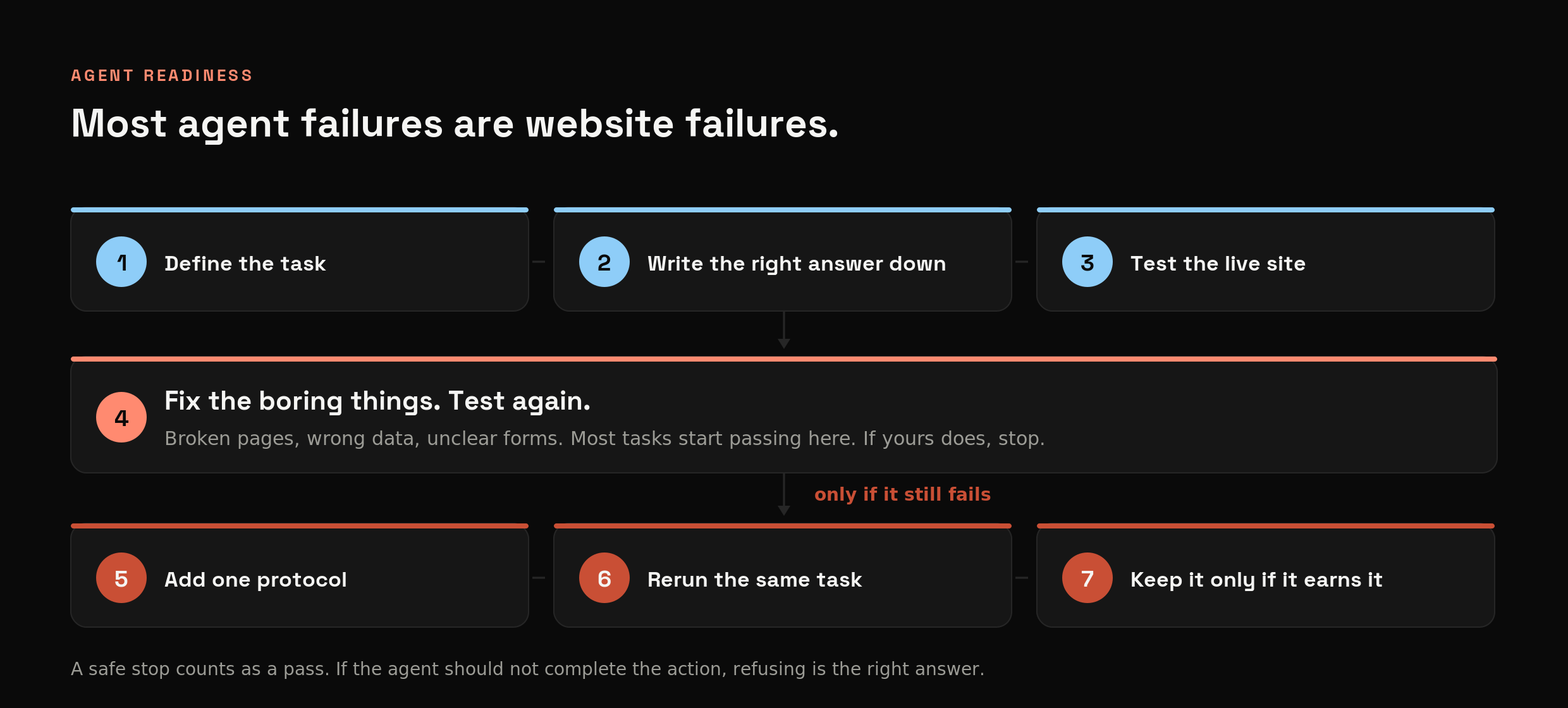
Start with one customer task that already carries commercial value: Finding an in-stock product under budget and adding it to a basket, choosing a SaaS plan and requesting a demo, checking travel availability and starting a booking. Then run it through the following steps.
- Define the task and success condition: Write one realistic instruction with the constraints a customer would actually give. Decide what completion means before you test, whether that’s the correct product selected, an accurate quote returned or a valid form submission created.
- Create a known-answer sheet: The correct product, price, availability, policy and next action, written down, so the team has something objective to compare against.
- Establish the no-protocol baseline: Ask an agent to complete the task on the public site as it stands. When something gets missed, check server logs and compare raw HTML, rendered pages, feeds and API responses.
- Fix the fundamentals first: Inaccessible content, inconsistent data, unclear forms, broken journeys. Rerun the baseline before assuming a protocol is necessary, because usually it isn’t.
- Add one protocol, in a safe environment: If a structural gap survives step 4, add the smallest suitable integration on staging. Annotate a difficult form with WebMCP, or expose an authorised product-data tool through MCP.
- Rerun the identical task, plus failure cases: An out-of-stock item, a contradictory price, an invalid input, an action requiring approval. A safe stop or handover counts as success when the action should not continue.
- Score it: Task completion, factual accuracy, manual interventions, time, safe failure, commercial events. Keep the implementation only if the gain justifies its cost and risk.
Agentic search changes the final measure. Success may be a completed task with no referral visit attached, which means analytics has to capture things it was never built to see: Agent access, task starts, approvals, failures, completions. Most stacks can’t do this yet, which is why you should start asking your analytics vendor now.
AI search actions you can take (and shouldn’t take) this week (that don’t hurt your SEO)
Everything above compresses into 8 moves. In the order I’d do them and none of them needs budget approval.
- Check what the crawlers can reach: Fetch your 10 most commercially important URLs as a bot and confirm each returns a 200 with real text in the initial HTML. Check
robots.txt, your CDN and any bot-blocking rules against OAI-SearchBot, PerplexityBot, ClaudeBot and Googlebot. - Read the logs before you read anything else: Which URLs are assistants actually crawling? If redirects, tracking paths and dead products dominate the list, that’s your first fix. Separate assistant, indexing and training activity before anyone reports a number.
- Close the entity gaps: Ask 4 assistants “what is [your brand]” and “who is [your brand] for” and write the answers down verbatim. Everything wrong, missing or generic in those answers is your content brief.
- Fix the freshness layer: Audit prices, availability, plan names and policies. Update Merchant Center feeds and Google Business Profiles. Add a visible last-updated date to pages carrying facts that move.
- Group your prompts into clusters: One cluster per commercially important persona and journey stage, so you can see which part of the funnel you’re invisible in. Load them into a tracker and run the identical set every time.
- Find the gaps against those prompts: Where a competitor is cited and you aren’t, look at what their page does that yours doesn’t, which is usually specificity, evidence or a stated limitation. Improve your strongest existing page. Publishing a new one per prompt is how you end up with a content farm.
- Work on the sources you don’t own: Identify the comparison pages and listicles cited for your best buying questions, check you’re described accurately and route recurring customer complaints back into product, because those complaints are being quoted.
- Run one agent test: Pick a task with commercial value and see whether an agent can finish it on your site. Expect ordinary website problems and fix those before considering any protocol.
If you only do one, do the first. Everything else assumes a machine can reach your pages and in my experience that assumption fails more often than anyone expects.
And one thing not to do as part of your AI search strategy
Publishing a “best [category]” listicle on your own blog with your own company at number 1 has been the most popular GEO tactic of the past two years and Lily Ray has documented what happened next: Brands losing 29% to 49% of their organic visibility, with blogs full of self-promotional listicles the pattern that kept repeating. Best case, the assistants ignore it and you’ve spent budget on a page nobody trusts. Worst case, Google reads it as self-serving review content and takes the rest of your blog with it. The upside is capped and the downside isn’t, so if you want to be in listicles, be in someone else’s and earn the place.
Most of this isn’t new. I hope the order it’s in and my own takes and tips along the way, help you build your own strategy, because handing you someone else’s would be useless.
AI search FAQs
What is the difference between SEO, AEO and GEO?
They describe 4 different outcomes within one discipline: SEO is about being findable in a ranked list, AEO is about being usable when a system answers a question directly, GEO is about visibility inside a generated response and LLMO is about being understood and referenced by the model itself. All 4 depend on the same foundation, because your content has to be crawlable, retrievable and credible before any of them can happen.
Is AEO or GEO replacing SEO?
No. Google’s own guidance states that “AEO/GEO is still SEO” for its products and supporting pages for AI Overviews and AI Mode still have to be indexed and snippet-eligible. What has changed is the range of outcomes worth measuring. A citation, a mention, an owned link and an action link are 4 different results and a page can win one while losing another.
Do I need an llms.txt file?
Probably not for AI search visibility. Ahrefs analysed 137,000 domains and found 97% of published llms.txt files received no requests at all in a month, with AI retrieval bots accounting for just over 1% of the traffic that did arrive. No AI bot requests a file that doesn’t exist, so publishing one puts you on nobody’s radar. It has genuine value in one case: If your customers use coding agents, those agents do fetch it. If you publish one, link to it, keep it small and treat it as a security surface.
Does content chunking improve AI search visibility?
Google says publishers don’t need to split pages into small chunks, that its systems can identify a relevant passage within a page covering several topics and that there’s no ideal word count. Clear headings and self-contained explanations are still good editorial practice and worth testing for retrieval. They aren’t a confirmed ranking factor and anyone presenting fixed paragraph lengths as a Google requirement is going beyond what Google has said.
How much website traffic actually comes from AI search?
Around 1.08% of total traffic is measurable as AI referrals, based on Conductor’s 2026 benchmark of 13,770 enterprise domains, with variation from 0.25% in Communication Services to 2.80% in Information Technology. Treat that as a floor. Attribution is incomplete across apps and surfaces and there’s no defensible multiplier for the missing share.
Why does my brand appear on Perplexity but not ChatGPT?
Because they’re different products with different retrieval systems and source preferences. Ahrefs found only 12% of URLs cited by ChatGPT, Gemini and Copilot ranked in Google’s top 10 for the same prompt and only 13.7% citation overlap between Google’s own AI Mode and AI Overviews. Same site, same content, different result, which is why each surface needs tracking separately.
How do I track AI search visibility?
Record 5 things separately: Whether an AI answer appears, which brands are included and in what order, how each is described, which pages and domains are cited and whether the cited source is owned, earned, community-led or commercial. Run a stable core prompt set so trends mean something and expect volatility. Profound found 40.5% to 59.3% of cited domains changed within a single month.
What is query fan-out?
One question triggering several related searches behind the scenes before an answer is composed. Ask for the best software for a small finance team and the system may separately search features, pricing, security, comparisons, customer experiences and alternatives, then assemble one answer from all of them. It’s why consistency across sources matters more than optimising a single page and why some of the sources involved will be ones you don’t own.
Work with me on AI search
If any of the above sounds like a problem you currently have - crawlers that can’t reach the pages that matter, an AI answer describing your brand wrongly, or a measurement story nobody can defend - tell me what you are seeing and I will tell you whether it is worth fixing.